বাংলা
 English
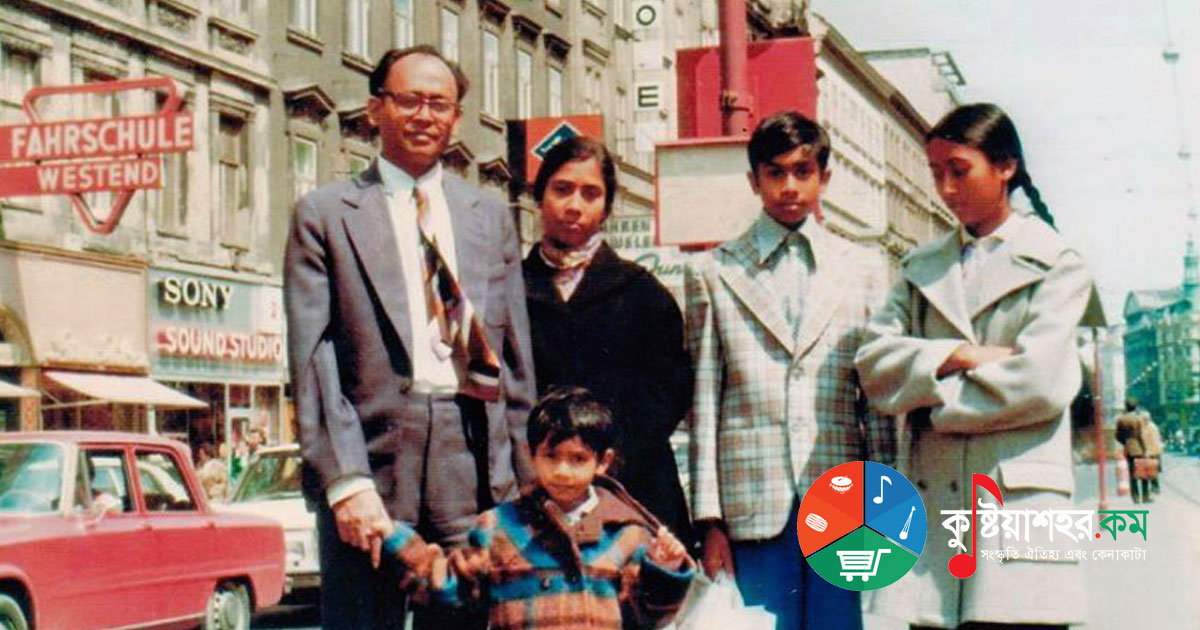
Hanifuddin Mia was Bangladesh's first computer programmer. Bangladesh's first computer arrived in 1964 [in what was then East Pakistan]. It was an IBM mainframe 1620 computer. Installing that huge machine took two large rooms. That house-sized computer was set up at the Atomic Energy Commission in Dhaka; it was a second-generation digital mainframe computer. It is worth noting here that it was through his hands that the first computer of Bangladesh — and of the then whole of Pakistan — the IBM 1620, came to be installed at the Bangladesh Atomic Energy Commission [adjacent to TSC].
Scientists and engineers of the Atomic Energy Commission, along with many institutions including the country's renowned seats of learning, used it for analysing scientific data, developing programmes, training and all kinds of research work. But one must know why the then Pakistan's first computer was installed at the Atomic Energy Commission in Dhaka. Mostafa Jabbar relates that the Pakistan government at the time planned to install the computer in West Pakistan. But apart from Hanifuddin Mia, no one else was capable of supervising and running this computer. So the government called upon Hanifuddin Mia to go to West Pakistan. Hanifuddin refused that call, and as a result the Pakistan government was all but compelled to install the computer at the Atomic Energy Commission in Dhaka.
Nowadays going abroad means heaven itself. At that time, for the people of East Pakistan, Pakistan itself was heaven. But Hanifuddin refused the beckoning of that heaven. How many people in this country were — or are — like that?
To know how Hanifuddin Mia became acquainted with the computer, one must go back to his youth. This accomplished son of Natore, the nuclear scientist Hanifuddin Mia, the pride of Bangladesh, was born on 1 November 1929 in Hulhulia village of Singra, Natore. He was the eldest of the two sons and one daughter of Rajab Ali Talukdar, a schoolteacher. Though the family wanted for nothing, he had to struggle for higher education. He passed matriculation from Calcutta University in 1946. In 1948 he passed the ISc examination from Dhaka University in the first division, and in 1948 he gained first division in BSc with distinction as well. Then, in 1952, from the same Dhaka University, he secured first place in the MSc examination in applied mathematics, standing first with a gold medal. Later, in 1960, he received training in analogue computer technique and digital computer programming from the Institute of Information Theory and Automation of the Czechoslovak Academy of Sciences in Prague.

In 1964 he received training at the MIT [USA] Computer Center in system analysis, numerical mathematics, advanced computer programming and operations research. In 1975 he took training in operating systems and system programming at the IBM Research Centre in London. Then, from 1975 to 1980, he worked at the International Atomic Energy Agency [IAEA] as a programmer-analyst on analysis, design, software implementation of computer applications and related matters. He taught part-time at Dhaka University in 1988; besides this, at various times he taught mathematics and computer subjects.
In family life, the country's first computer programmer Md Hanifuddin Mia was the father of one son and two daughters, his wife being Farida Begum. His son Sharif Hasan worked as an engineer at Siemens Bangladesh for 23 long years, and now works at a private housing company. His daughter Dora Shirin is a doctor by profession, and his other daughter, Nita Shahin, is a homemaker. This accomplished son of Hulhulia village in Natore district held the post of Director of the Computer Service Division of the Bangladesh Atomic Energy Commission. Although his formal fields of study were computer science and numerical mathematics, he had an immense interest in acquiring knowledge of varied subjects including art and literature.
Besides Bangla and English, he knew Urdu, Arabic, Hindi, German and Russian. Meanwhile, in 2001 the first computer used in the country was preserved in the National Science and Technology Museum. A year earlier, in 2000, he gifted two IBM desktop computers to his village Hulhulia High School. From then on, the number of computer engineers from that village kept growing alongside the doctors; more than a hundred engineers have risen from this little village. On 11 March 2007 he set out for the land of no return. Before his death he had, at various times, taught mathematics and computer subjects. He was also one of the founders of the Bangladesh Mathematical Society. Mohammad Hanifuddin Mia's name is deeply bound up with the onward march of computer science in Bangladesh.
Mostafa Jabbar holds a very short memoir of Hanifuddin Mia. In April 1997 Bangladesh Television first permitted me to make a programme on computers. Before that, no such programme had been made in Bangladesh. I had long been trying to make one, but since the government in power until 1996 did not like me, and with the sympathy of the post-1996 government, a renowned BTV producer was allowed to make my programme. That producer, Lutfor Rahman Talukdar, is no longer with BTV; but his assistant Barkat still makes my computer programmes, and Barkat can still remember that programme. The programme was always educational, but I thought of making the first few episodes with a somewhat different flavour. That is why I built my first TV programme around the computer that came to Bangladesh in 1964. We then learned that the computer was at the Savar Atomic Energy Commission. Lutfor bhai booked BTV's outdoor camera unit. I wanted to interview the person who had first used that computer. Through SM Kamal, the first president of the Bangladesh Computer Samity, I found Md Hanifuddin Mia. Later I learned that he was the brother-in-law of Sajjad Hossain, the second president of the Bangladesh Computer Samity. Sajjad bhai had eloped to marry, and Hanifuddin was the matchmaker of that marriage.
That interview was a milestone in the history of computers in Bangladesh, because that day Hanifuddin told the story of how the computer came to this country. I was astonished to learn that we got the computer because he refused to go from Bangladesh to Lahore in Pakistan. I can still recall that before the video camera his first words were spoken in a shy voice. This rather timid man's manner was so warm that I was won over.
For a long time afterwards I lost track of him. Kamal bhai lived around the Computer Samity, but Sajjad bhai had moved quite far away, so I could no longer keep in touch. I knew he lived in Uttara; I had no other connection.
At the start of this year, when I went to PATC Savar to teach a batch of government officials, I spoke about Hanifuddin there. In truth, whenever I have had the chance since 1997, I have spoken of Hanifuddin Mia. After class, as I was leaving, a young man came up and told me his home was Hulhulia village — the village where Hanifuddin was born and where his grave lies too. I asked him for the address of any of Hanifuddin's descendants, and he gave me the phone number and home address of his son Sharif Hasan Suja. That day I felt I had held the moon in my hands.
As it happens, in early 2014, while president of the Bangladesh Computer Samity, I tried to celebrate 50 years of computers in Bangladesh. Before that I had tried to celebrate the Samity's 25 years too, but the country's political situation did not favour me. Still I did not give up. It seemed to me that, if nothing else, at least the name of Hanifuddin Mia had to reach the people of the country's ICT sector. In a word, I went door to door to everyone connected with it. That very last effort worked. When the ICT Division and the Bangladesh Computer Samity organised the Bangladesh ICT Expo, for one reason or another I became chairman of its seminar committee.
Through that I came to speak with the State Minister of the Division, Junaid Ahmed Palak. The moment Hanifuddin's name was uttered, Palak agreed. The Division's officials placed an extra duty on my shoulders — to find his family. I did that work too, and learned that his wife was gravely ill. The night before the honours ceremony I spoke with that lady; she refused to come. But I somehow pressed her into agreeing, and that day she came not only to the award ceremony but brought her third generation as well — her grandson Irfan, her son's son. I believe this was a milestone event in the history of Bangladesh's information technology. Standing on the stage that day, Irfan said: I did not know my grandfather was a man of such stature. In truth, we too did not know how great a man he was.