বাংলা
 English
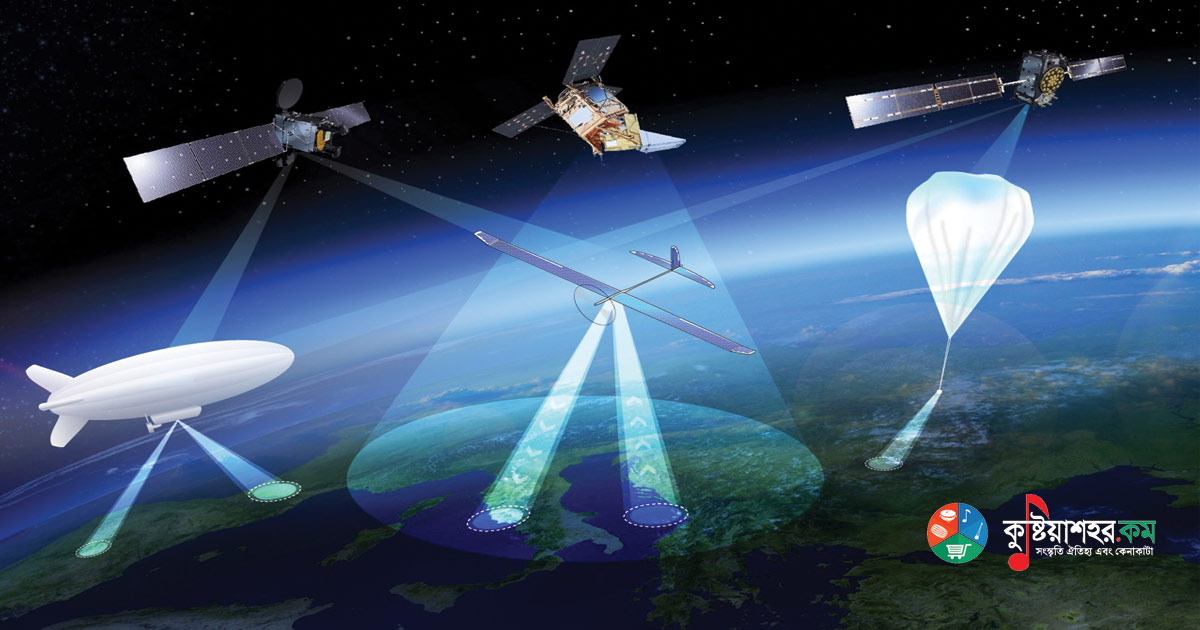
A satellite is an artificial satellite sent into space through a scientific process. Through satellites we get news of different parts of the world in an instant. A satellite is carried into orbit in the cargo bay of a rocket or space shuttle. During launch the rocket is controlled by an Inertial Guidance System (IGS) mechanism, and to break past the Earth's gravity the rocket must race at an acceleration of 25,039 miles per hour.
When placing a satellite, unless a balance is struck between its orbital velocity and inertia and the pull of the Earth's gravity, that gravity can drag the satellite back down to the surface. For this reason a satellite is made to circle an orbit 150 miles high at nearly 17,000 miles per hour. In essence, what speed it must reach depends on how high above the Earth the satellite sits. A satellite placed 22,223 miles above the Earth circles it at 700 miles per hour; the satellite, like the Earth, revolves through 24 hours. Geostationary satellites, however, stay in one place.
These are used for weather and communication work. Satellites travel in elliptical paths around the Earth's orbit. Generally, satellites of various kinds are sent into orbits 80 to 1,200 miles high. What altitude a satellite will occupy depends on the kind of work it does. For example, science satellites — used for research on plants and animals, for monitoring the grazing of wildlife, and for research in astronomy and physics — are placed at 300 to 6,000 miles. GPS (Global Positioning System) satellites are placed at 6,000 to 12,000 miles. Each kind of satellite has its own characteristics and structure, though all satellites usually share some things in common.
A satellite's body is built on a frame of metal alloy called the bus; all of the satellite's instruments sit inside it. Every satellite carries solar cells and a battery for storing power, and its power system is monitored from the Earth at all times. A satellite has an onboard computer that controls it and monitors its various systems. Another fundamental feature of the satellite is its radio system and antennas.
History of the satellite
The history of artificial satellites and space travel is not very old — it is brand new. You will be astonished to know that the first step of space travel was taken on 4 October 1957, and it was begun by the then Soviet Union, which launched into space an artificial satellite named Sputnik-1. Sputnik means travelling companion. On 3 November of that same year they sent another artificial satellite, Sputnik-2, into space. The first American artificial satellite was named Explorer-1; it was sent into space on 31 January 1958. The Soviet satellite Vostok-1 was the first to circle the Earth carrying a human being. The man who first went to space was Yuri Gagarin, a citizen of the Soviet Union; on 12 April 1961 he rode Vostok-1 around the Earth. Riding the satellite Vostok-6, the first Soviet woman cosmonaut, Valentina Tereshkova, travelled to space in 1963. Intelsat-1 was sent into space as a communication satellite for commercial use. The first satellite sent for remote sensing was Landsat-1, launched in 1972. For establishing international connections, a satellite named the Apollo-Soyuz Test Project was first sent to space in 1975. Countries of the world have so far sent more than a thousand artificial satellites into space. Several hundred satellites are in use at present, and thousands of unused satellites or their parts are orbiting the Earth as space debris.
Satellite orbits
The egg-shaped path along which satellites keep circling in space is called the orbit. By altitude from the Earth's surface, this orbit can be divided into three kinds: 1. Low orbit — its altitude is up to 1,240 miles or 2,000 kilometres from the surface; 2. Medium orbit — from 2,000 km to 35,786 km above the surface; 3. High orbit — from 35,786 km up to infinity.
Kinds of satellites
Every satellite is designed for a specific task. On the basis of the task, satellites can be divided into several kinds.
Weather satellites:
This satellite is used for observing the weather; photographs of the Earth's weather are captured through it — for example, the TIROS, COSMOS and GEOS satellites.
Communication satellites:
In a communication satellite, signals or information are exchanged through the satellite; broadcasting satellites belong to this class too. This communication is also called space communication. Such a satellite carries an antenna system, a transmitter, a power supply and a receiver. In this system, a modulated microwave — the signal plus a high-frequency carrier wave — is sent from an earth-station transmitter up to the satellite. The satellite amplifies that modulated wave and sends it down to receiving stations set up on the Earth. Geostationary satellites sit in geostationary orbit.
Now, if a satellite is placed at an altitude of 35,786 km, it revolves at the same speed as the Earth — that is, it circles the Earth in such a way that one revolution takes it 24 hours; and since the Earth too takes 24 hours to spin once on its own axis, the satellite appears stationary relative to the Earth. Such a satellite is called a geostationary satellite, and this orbit the geostationary orbit. This orbit is the most useful for communication, but it too has a disadvantage: because of the Earth's curvature, a single communication satellite placed in this orbit cannot cover the whole Earth. To cover the whole globe, three satellites must be placed in this orbit. If all three satellites sit 120 degrees apart from one another in geostationary orbit, the whole Earth can be covered simultaneously.
Navigation satellites:
This satellite is used to detect and navigate aircraft and seagoing ships — for example, the GPS NAVSTAR satellite. GPS is a satellite-based navigation system: a network of 24 satellites that can transmit information and pictures of any location on the Earth continuously, at any time and in any weather.
Earth observation satellites: this satellite is used to survey the Earth's surface and take pictures of its various parts.
Military satellites:
This satellite is used for military purposes only. Its main tasks are nuclear monitoring, radar imaging, photography and observing the enemy's movements.
The number of satellites in space
The Soviet Union was the first to successfully launch a satellite into space, sending up Sputnik-1 in 1957 with the help of the Sputnik-PS rocket. After that, the United States and other countries too became capable of sending them. So far, several thousand satellites have been launched into space from more than 50 countries, but only 10 countries on Earth have managed to launch satellites into space with their own technology from their own launch centres. They are the Soviet Union (1957), the United States (1958), France (1965), Japan (1970), China (1970), the United Kingdom (1971), India (1980), Israel (1988), Ukraine (1992) and Iran (2009). The number of satellites now circling in space is 1,071 — and the fun fact is that half of them were launched by the United States.
Data and credits: the Internet and the Samhoyar blog