বাংলা
 English
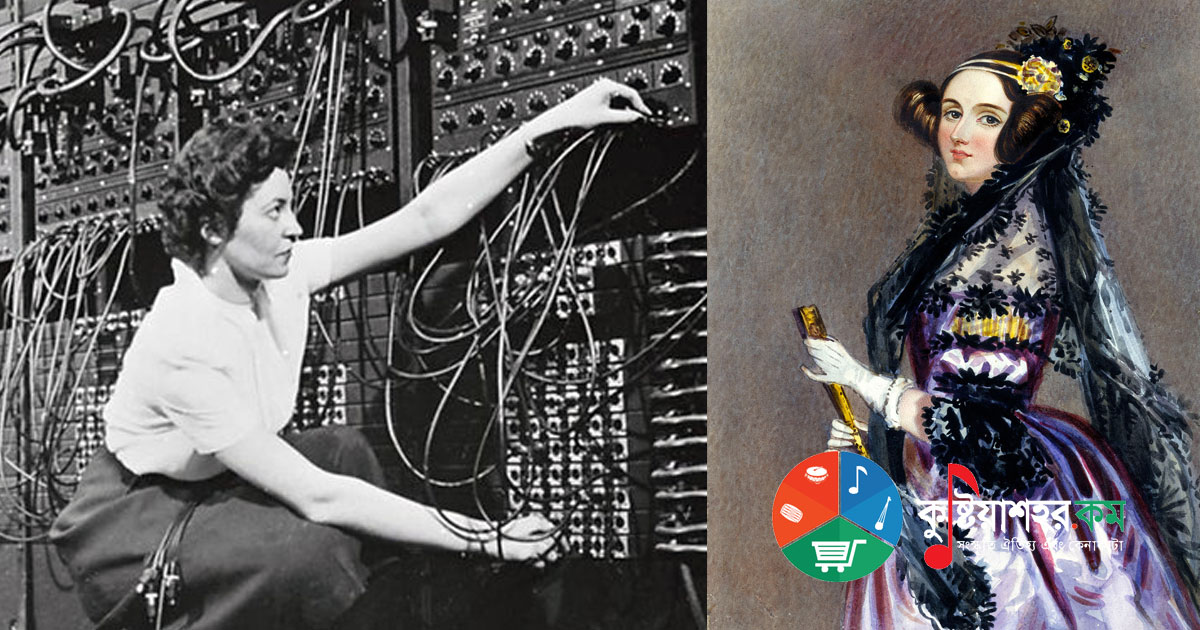
Augusta Ada King-Noel, Countess of Lovelace (née Byron; 10 December 1815 – 27 November 1852) was an English mathematician and writer, chiefly known for her work on Charles Babbage's early mechanical general-purpose computer, the Analytical Engine. Her notes on the engine include what is recognised as the first algorithm intended to be carried out by a machine. As a result, she is often regarded as the first computer programmer.
The founder of scientific computation, Ada Byron, was born in London — and it was there that she died. Augusta Ada King-Noel was the daughter of the Romantic poet Lord Byron and Anne Isabella Milbanke. Born on 10 December 1815, this woman mathematician is known as the world's first computer programmer. In her honour, in 1980 the United States Department of Defense named one of its computer languages Ada.
But just one month after Ada's birth the couple separated, and only four months after her birth Lord Byron left England forever. Ada never met her father. In 1824 Ada's father died in Greece. It was her mother, Lady Byron, who raised her. Her full name was Ada Augusta King, and she was called the Countess of Lovelace, or simply Ada Lovelace. Ada lived only 36 years; on 27 November 1852 she died of uterine cancer and excessive bleeding.
Her life was glorified in a struggle between passion and reason, poetry and mathematics, and failing health and bursts of energy. Her mother, Lady Byron, wanted by no means for her daughter to become poetic like her father. She wanted Ada to grow up educated in mathematics and music, so that the dangerous poetic tendency could be kept in check. But that inherited legacy surfaced as early as 1828 — at that time she was designing a flying machine. Mathematics gave her life the speed of flight.
At the age of 17 [1832] her mathematical talent blossomed. From childhood her mother had wanted to make her proficient in mathematics so that her father's influence would never be reflected in her. Before 1841 Ada did not even know that Lord Byron was her father. The mathematician and logician De Morgan was her teacher! She also knew Sir Charles Dickens, Charles Wheatstone and the scientist Michael Faraday. On 5 June 1833 she met Sir Charles Babbage, and a fairly close — even romantic — relationship grew between them. Babbage was fascinated by Ada's extraordinary intellect, fluent pen and talent; in his own writing Babbage described Ada with the title "enchantress of numbers". Later she married William King, who became the first Earl of Lovelace.
It is worth noting that Charles, the father of the modern computer, invented a differential machine, whose purpose was to compute the powers of various numbers — that is, to find the result of multiplying a number by itself once, twice, three or four times. Interestingly, while building this subtracting machine he dreamed of building another new machine, and it is this machine that has made him immortal in history. He named it the Analytical Engine, or the analytical machine. While Sir Charles William Babbage was absorbed in the obsession of inventing his difference machine — known as a computer — Ada, through her analytical mathematical power, understood the immense possibility of these computers' number crunching. Charles Babbage therefore wrote about her in his book Decline of Science in England. This exceptional woman's promising ideas gave further momentum to Babbage's work. Many features of the modern automatic computer were present in this machine of Babbage's imagination. Fortunately for us, the poet's daughter Ada Byron was associated with many of Babbage's ideas. Ada Byron wrote this machine's programme, and that is why she is called the world's first programmer.