বাংলা
 English
The glorious history of the life of a struggling - Abdur Rouf Chowdhury
Mr. Abdur Rauf Chowdhury was born on 18 August 1935 into a respectable, wealthy Muslim family of Chhatragachha village under Mirpur upazila of Kushtia district. His father's name was the late Abdul Jabbar Chowdhury. Mr. Abdur Rauf Chowdhury passed matriculation from Kushtia Muslim High School in 1950. After obtaining his bachelor's degree from Kushtia College in 1962, he was admitted that very year to the Department of Law at the University of Dhaka and completed the course in due time. But on the eve of the examination, detention under the Safety Act made it impossible for him to sit the exam.
Mr. Abdur Rauf Chowdhury began his political life in 1945 by joining the protest marches of the historic Rashid Ali Movement. At the time he was a sixth-grade student. He took an active part in the anti-British freedom struggle, that is, in the Pakistan Movement.
As one of the most active members of the volunteer corps of the Muslim Students' League and one of the leaders of its Kushtia district branch, he took part in the 1952 Language Movement. He was elected VP of the Kushtia College students' union in 1957-58. In 1962 he became president of the University of Dhaka branch of the Students' League, and played an active and nationally notable role against the report of the anti-people education commission.
In 1963 he was elected convener of the central committee of the Students' League's sub-committee on 'Framing the Constitution and Programme', and the 'Constitution and Programme' he presented to the central council was adopted unanimously after a night-long lively discussion at the conference. In organising the democratic movement of the NDF - formed against Ayub's autocracy under the leadership of Huseyn Shaheed Suhrawardy and a combination of nine leaders - Mr. Chowdhury played a notable role in Kushtia district.
In 1963 he led the movement against the presence of the notorious governor and chancellor Monem Khan at the Rajshahi University convocation festival and was arrested. Under the students' strong pressure and through tactics he was rescued from the clutches of the police. But a warrant remained outstanding against him for a long time.
In 1966 he was elected general secretary of the Kushtia district Awami League. That same year, on the occasion of observing the historic all-party May Day, although he was the principal accused for violating Section 144, the police were forced to release him under pressure from the workers and the public.
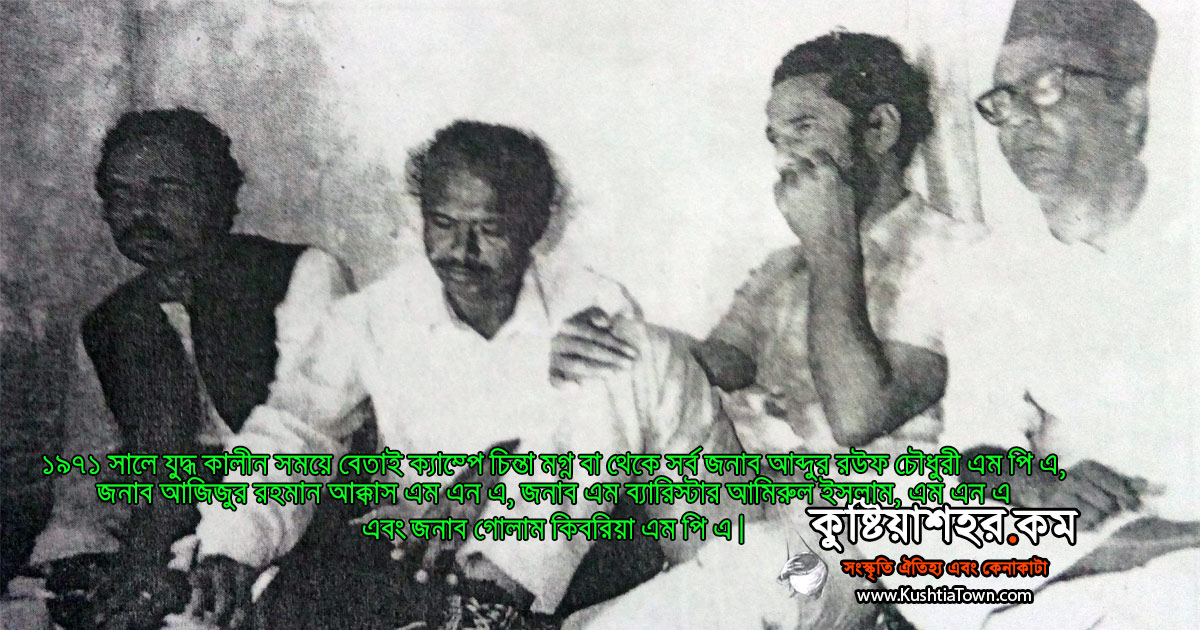
A pensive Mr. Abdur Rauf Chowdhury, MPA, at the Betai camp during the war in 1971, with Mr. Azizur Rahman Akkas, MNA, Mr. Barrister M. Amir-ul-Islam, MNA, and Mr. Golam Kibria, MPA

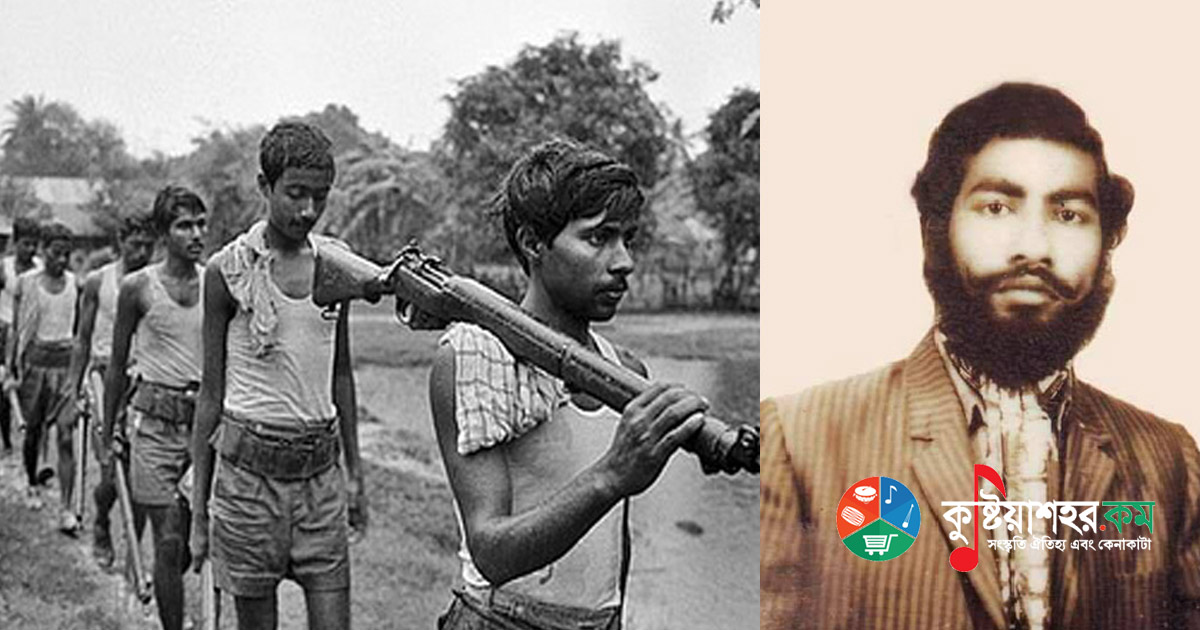
Mr. Abdur Rauf Chowdhury, APA, addressing the freedom fighters at Karimpur, India, in 1971
In 1965, as a student leader in the entourage of Miss Fatema Jinnah, the D.A.C-nominated presidential candidate against Ayub, he toured the Khulna and Rajshahi divisions. He also played a notable role in organising P.D.M, the united front against the then autocratic government of Pakistan. As a member of the then East Pakistan P.D.M executive committee, through the opportunity of close association with the national leaders of East and West Pakistan, he played a significant role in national politics. In 1967, on the occasion of observing Political Prisoners' Release Day, he was detained under the Safety Act on charges of violating Section 144 and of so-called sedition, and was later released by the High Court.
In the historic mass uprising of 1969 he played an active and notable role. In the 1970 election he was elected a member of the then East Pakistan Provincial Assembly (MPA). On 31 March 1971 he led the Kushtia Liberation War against the occupation forces. In the Liberation War, organising the BDR (then EPR), the police, the Ansar and the freedom-crazed populace, he drew up battle plans against the Pakistani occupation forces, and brought the EPR men with their weapons from the Indian border to Kushtia and coordinated them. He attacked the occupation forces' big strongholds, the police lines and the Zilla School, and conducted battles at the thana and the T&T building. Using his residence in Kushtia as a fortress of the Liberation War, he carried out an attack on one of the occupation forces' positions, the Kushtia thana and T&T building. For this reason the occupation forces later attacked and destroyed his homestead.
Later Mr. Abdur Rauf was elected chairman of the Mujibnagar Government's South-Western Zonal Council (formed by combining greater Kushtia and Pabna districts). At that time, with the MNAs and MPs combined, he was counted an MCA (Member of the Constituent Assembly).
After Bangladesh won independence, as an MCA he played an active role in drafting the country's constitution. He was then appointed chairman of the Kushtia Relief and Rehabilitation Committee, and he discharged the duties entrusted to him with distinction.
Next he was elected president of the Kushtia district Awami League, and in the 1973 election was again elected a member of the national parliament. In April 1975 he toured the Australian continent with a parliamentary delegation. Later he toured Singapore, Kuala Lumpur and Bangkok.
In 1976 he became one of the founding members of the Democratic League, and later at the council session was elected vice-president of the national committee.
From 1982 onward, as president of one faction of the Democratic League, he played an active role as one of the leaders of the seven-party united front in the historic anti-autocracy five-point movement. He also played a notable role as a member of the 22-party liaison committee.
After the fall of autocracy, with the aim of adopting a parliamentary democratic system, giving democracy an institutional shape, and uniting and strengthening the nationalist-democratic forces, he dissolved his Democratic League and merged it with the Bangladesh Nationalist Party. In the election of 27 February 1991, contesting as a BNP candidate, he was elected a member of parliament. He became chairman of the public accounts standing committee of the national parliament and a member of the standing committee relating to the Ministry of Home Affairs and of various selection committees. A man of a richly colourful life, Mr. Abdur Rauf Chowdhury has continued an equal presence in social work alongside politics. He founded, and remains involved with, many educational institutions in his area, including Chhatragachha Primary School, a high school, Halsa High School and Amla College. He has served, and continues to serve, in various posts including chairman of the governing bodies of many of these institutions.
He remains directly involved as a founder and in the activities of the district sports organisation, the public library, the fine arts academy and other socio-cultural institutions. He was founder chairman of the Kushtia district Red Cross and a member of its national executive committee.
In personal life:-
Wife, Advocate: Nargis Chowdhury, a lawyer and social worker.
Son Barrister Raghib Rauf Chowdhury practises law in the Supreme Court.
Daughter Alma Chowdhury, having passed English (Honours) with distinction, is studying at Monash University in Melbourne.
Youngest son Sarek Rauf Chowdhury is a third-year student of architecture.