বাংলা
 English
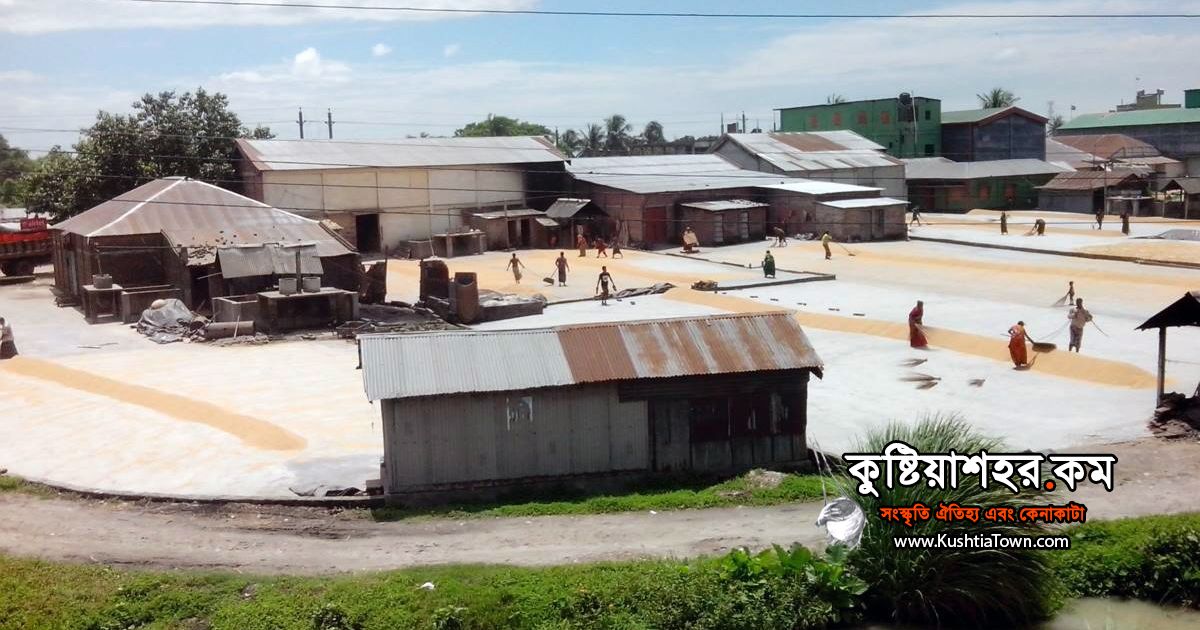
Khajanagar of Kushtia is a remote village of Bangladesh. Yet though a village, its fame is worldwide. For this place is no mere village - it is a vast industrial town of rice production. The village has now become one of the country's foremost centres at once of rice production, conversion to improved varieties, and marketing. From this rice-industrial town nearly one-third of the whole country's demand is met.
At the same time, packaged improved rice is exported from Khajanagar to 38 countries. Around the Khajanagar-Ailchara rice industry, nearly 800 big and small rice mills have sprung up. Besides, there are more than two thousand rice-drying yards for boiling and drying paddy and other processes. On average about eight thousand tonnes of rice are produced there every day. Hundreds of warehouses, big enough to stockpile 20-22 thousand tonnes of rice, have also grown up in Khajanagar. Even the ordinary homes here are engaged in various commercial processes of production, storage and supply. All told, the vast labour of more than ten thousand men and women workers goes on day and night.
Without any government or private support or patronage, the rice mills and drying yards here have been built bit by bit through the tireless toil of the local residents. At one time the people of the Chilmari, Bajumara and Philipnagar char areas, dispossessed by the erosion of the Padma, took up the rice trade centred on Khajanagar as a means of survival. Today it has expanded many times over and grown into a vast industrial town. Wahiduzzaman Orko, owner of Sugondha Rice Mill, says the famous Miniket brand in the capital Dhaka is a creation of this very Khajanagar. Even various varieties of rice produced here are being exported to Italy and Germany.
Twenty-two or so rice mills of Kushtia - including Rashid Agro Food, Khazana Mill and Swarna Auto Rice Mill - play an important role in controlling the country's rice market. Each big mill produces 700 tonnes of rice a day, and small ones up to 50 tonnes. Khajanagar lies in Bottoil union of Kushtia Sadar upazila. While Bottoil union has 36 thousand permanent residents, as many as fourteen and a half thousand people live in Khajanagar village alone. Nine in every ten people of this village are closely bound to the rice industry. Some are workers, some traders, and some owners of mills or drying yards.
No corpses now - only songs of life's victory:
Only a decade and a half ago Khajanagar and its surroundings were plagued by extremists, with bloodied corpses lying scattered here and there. Now, after only a few years, the same place resounds with the triumph of life. A rice revolution has taken place. 'Farmers grow the paddy and Khajanagar makes the rice' - so goes the saying on everyone's lips. Tofazzal Hossain, owner of Khajanagar Byapar-i Agro, says he had a homestead on a Padma char of Chilmari. When his home was washed away in the 1992 flood, he moved with his whole family to Khajanagar merely to still the pangs of hunger. At first he somehow earned a living driving a rented van, and later joined a rice mill as a worker. In time his luck turned. He began running a mill on a partnership basis. Afterwards, with help from banks, NGOs and acquaintances, he built his own auto rice mill. Tofazzal's is one of many tales of changed fortune here. Almost every one of those who are big businessmen today rose from being workers.
A joyful bustle of work:
Khajanagar now has 250 mills of the middle class. There are 25 auto colour-shooter mills and 10 large dryer-auto mills. Each auto rice mill can produce about 2,500 maunds of rice per run. These modern mills recruit staff as day labourers, packing men, warehouse workers, general labourers, helpers, machine operators, technical man-makers, electrical assistants, managers, salesmen, cashiers and directors. Each factory runs one shift in eight hours. 20-30 men and women work in each shift.
According to demand the mills are kept running day and night in three shifts. The whole Khajanagar area seems to float day and night in the joy of work. From children to men and women, old and young, everyone passes their time in one work or another. Over seventy-year-old Nur Mohammad, though his eyesight is weak, spends his days mending sacks with a large needle and jute twine. The old woman Karimon Bewa, in a hunched posture, fills sacks with the husk and straw picked out from the rice. When tired they lie down or sit here and there, and chat now and then. Yet amid all this joy there are problems too. The residents' chief problem is drainage. Local mill owners have eased the problem somewhat on their own initiative. The government has taken no step to solve it.
Hit by counterfeit brands:
The rice produced in Khajanagar is famed at home and abroad. Yet exploiting that fame, a class of cheats and fraudsters has started a brisk trade in inferior rice under the 'Khajanagar rice' brand. Buyers are being cheated buying rice under these brands. This dishonest ring of traders markets everything from ordinary rice to polao rice. The mill owners and traders concerned say that, in collusion with certain ultra-profit-hungry rackets in the capital, the cheats here are relentlessly flooding the market with rotten, foul-smelling, low-grade rice sealed in bags big and small under various names and brands.
Among quality rices, notable are Rashid's Miniket, Siraj's Miniket, Dada Rice, Joarder Rice and the rice of Natore Auto Rice. For aromatic rices like chinigura and kalijira, there are high-grade rices under the Irfan, Mozammel, Sagor Special, Rajnigandha, Sonar Chabi, Saheb Babu, Abul Hossain, Munjur, Mintu and Anowar Special brands. Yet because counterfeits are marketed under the same names, the original producers are being harmed. Seizing on this brand loyalty, some dishonest wholesalers of the capital's Babubazar, Badamtali, Chhota Katra, Moulvibazar and other areas are cheating buyers.
Source: Daily Inqilab