বাংলা
 English
Liberation War activist Barrister M. Amir-Ul-Islam:
During the critical period of the Liberation War, Barrister M. Amir-Ul-Islam’s role was a glorious one. With the aim of directing the war and winning international support for it, he was entrusted with all the arrangements for the oath-taking ceremony of the government in the mango grove at Baidyanathtala in Meherpur, then part of Kushtia. From that, at home and abroad, Bangladesh’s capital came to be known as ‘Mujibnagar’.
In this way, too, Kushtia earned the glory of becoming the first capital of independent Bangladesh. There, in establishing the "Government of the People's Republic of Bangladesh" - with the Father of the Nation Bangabandhu Sheikh Mujibur Rahman as President, with Syed Nazrul Islam as Acting President in his absence, and with Mr. Tajuddin Ahmad as Prime Minister - the glorious role of Barrister M. Amir-Ul-Islam was highly significant. At that time he was appointed the Prime Minister's chief aide. While discharging that responsibility, he arranged for letters seeking recognition to be sent on behalf of the Government of Bangladesh to the various states of the world. Since Bangladesh had no formal recognition at the time, international correspondence was all but impossible, so the letters were sent through the courtesy of East Germany.
In the liberation struggle, taking Mr. Tajuddin with him, he travelled from Dhaka via Calcutta to Delhi and held talks with Mrs. Indira Gandhi. By forming the government at Mujibnagar, he carved out his place before the nation as a highly capable organizer. At that time he invited his personal friends and internationally known figures to Mujibnagar and briefed them on the true state of the Liberation War. Among them were Mr. Peter Shore, former minister of the United Kingdom and leader of the Labour Party, MP; Mr. John Hardlastol, MP; Donald Chesworth, MP; Michael Barnes, Douglas Mann, Father Hardlastol and others. These leaders built a mass movement across the whole of the United Kingdom for Bangabandhu's release, for an end to the genocide in Bangladesh and for the recognition of Bangladesh. As a result of their tireless efforts, a motion in favour of Bangladesh's liberation struggle was adopted in the British Parliament. Through these personal friends, Barrister M. Amir-Ul-Islam's appeal reached every British representative, and an appeal bearing the signatures of more than two hundred MPs in support of Bangladesh appeared in The London Times, the Daily Telegraph and almost every leading daily of the United Kingdom. At that time, buying arms and ammunition for the freedom fighters and raising foreign aid for allied needs had become indispensable, and in this matter Barrister M. Amir-Ul-Islam showed extraordinary success. With the help of his friend, British MP John Stonehouse, he had the renowned artist Bimal Mallik design postage stamps bearing Bangabandhu's likeness. Throughout this whole process Barrister M. Amir-Ul-Islam gave outstanding talent and invaluable labour.
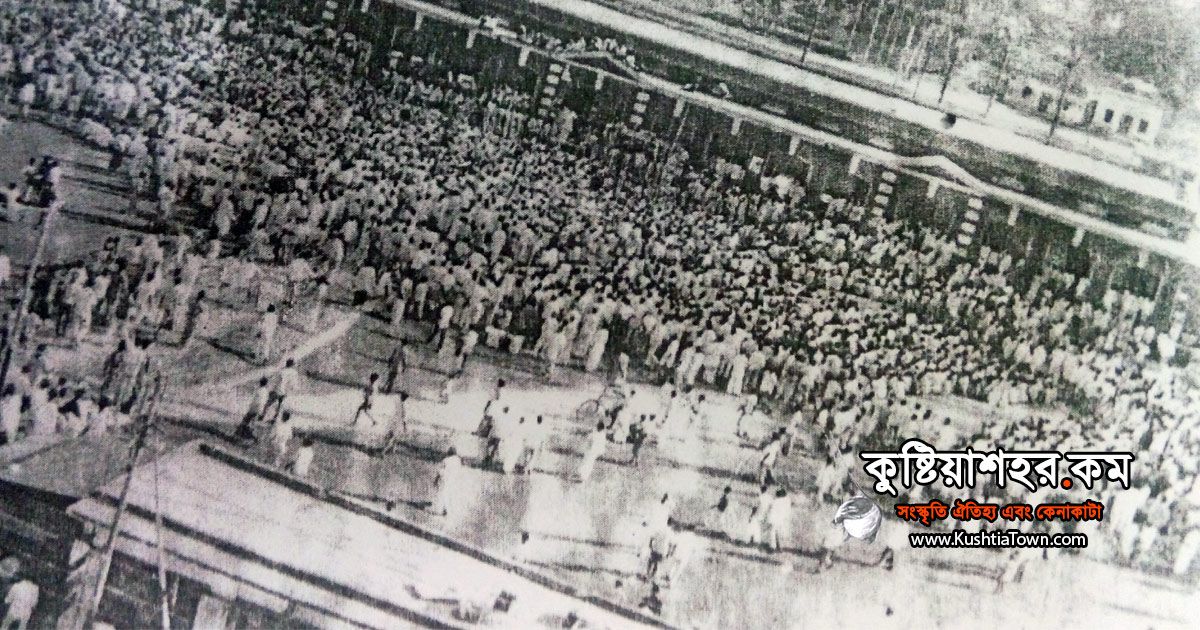
A scene of hoisting the flag and reading out the declaration of independence on the Kushtia Islamia College grounds on 13 March 1971.
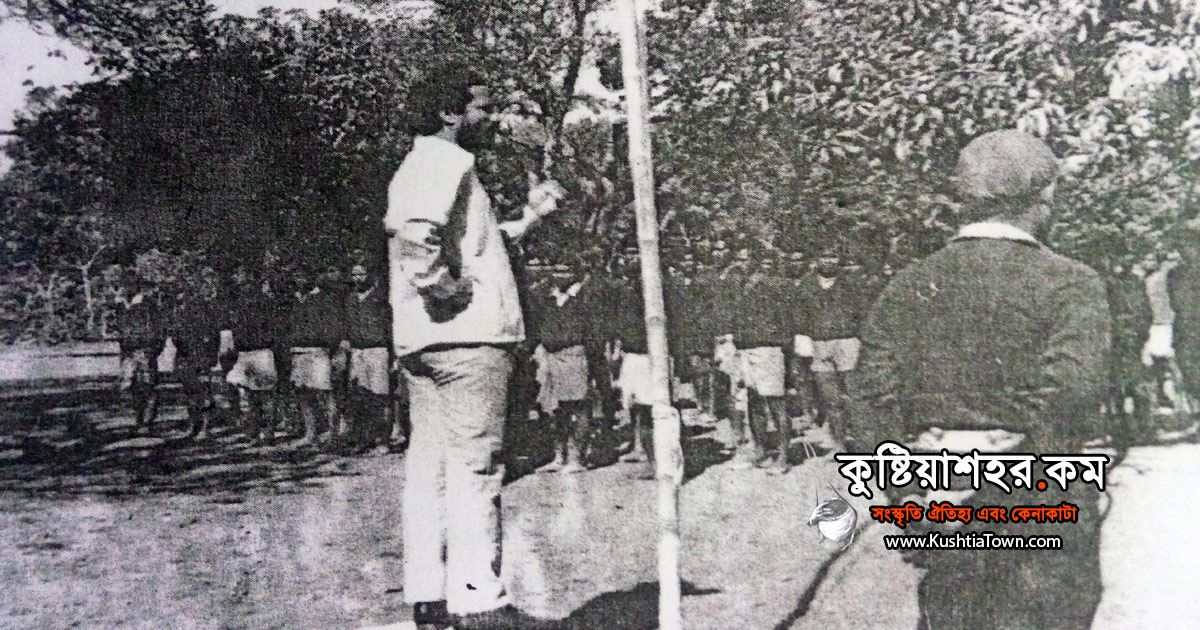
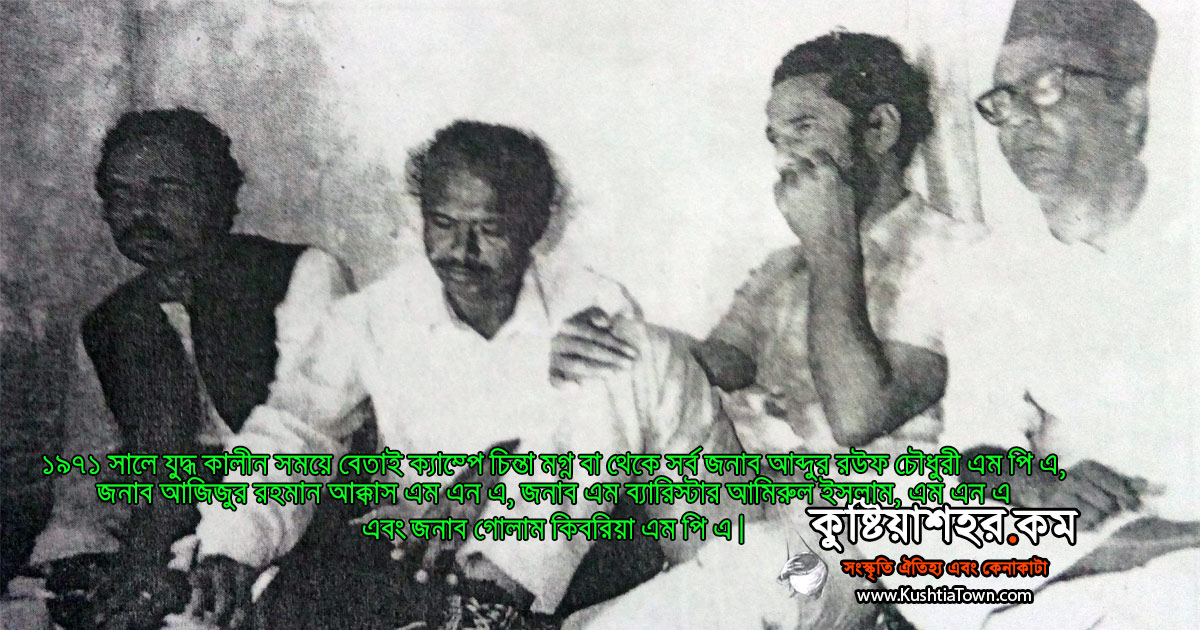
Barrister M. Amir-Ul-Islam at the Karimpur freedom fighters' camp.
On 1 August 1971, on the occasion of the inauguration of a Bangladesh post office at Patgram, a liberated zone belonging to a district of the northern region, an Australian team - including Mr. Donald Chesworth of London - went there under Barrister M. Amir-Ul-Islam's leadership, and through them a message about Bangladesh's postage stamp was sent to the Prime Minister of Australia.
Barrister M. Amir-Ul-Islam arranged to send the world-famous "Omega" team from Mujibnagar into areas under the control of the occupation forces. The occupation forces arrested members of that team, and the news spread around the world at great speed. As a result, the people of the world came to know of Bangladesh's liberation struggle and the atrocities of the Pakistani forces. During the war, in Patgram - Bangladesh's first liberated zone - Barrister M. Amir-Ul-Islam worked ceaselessly to bring the police lines, post office, thana, court-cutcherry and the like under the direct administration of the Government of Bangladesh. He took Prime Minister Mr. Tajuddin Ahmad to visit Patgram and presented to the honourable Prime Minister plans for, among other things, an advertising film to be produced under the title "See Bangladesh" for screening abroad, an international tourist centre, an airport, and programmes for exporting jute and tobacco. The UNHCR chief Sadruddin Aga Khan gave an interview in the liberated zone of Kashipur in Jessore, highlighting scenes of genocide, rape, arson and torture inside the country, and managed to make it clear that unless the country was freed from these occupation forces the bloodshed would not stop and the refugees could not be brought back home. He sent Veena Kewley of Granada Television to the eastern sector of the war, Major Khaled Mosharraf's sector, and the documentary footage sent back convinced the world of the breadth and effectiveness of the Liberation War and of its real promise. In this way, for nine months he worked tirelessly - from managing the delivery of necessary information, supplies and equipment to the freedom fighters' camps to getting this news out to the international world and building special public opinion in favour of the Liberation War.
Campaign for the recognition of Bangladesh:
Barrister M. Amir-Ul-Islam gave unstinting cooperation to any campaign for winning international support for Bangladesh. For instance, with the approval of the then Prime Minister of India, Mrs. Indira Gandhi, he lent a helping hand to the documentary film Nine Months to Freedom being made under the direction of the Indian photographer Sri Shuk Dev. Besides this, at various times he travelled to many countries of the world and campaigned everywhere for the recognition of Bangladesh. For the campaign to gain United Nations membership he went to New York as Bangabandhu's special envoy, and to Yugoslavia, Tunisia, France and England to gain membership of the Non-Aligned Movement. During these tours, Mr. Islam carried Bangabandhu's message to many of the world's leaders, including Marshal Tito, Habib Bourguiba and Yasser Arafat, smoothing the way to broad international recognition for Bangladesh. At the smaller non-aligned conference in Algeria he acted as Bangabandhu's advance representative and played an active role in gaining Bangladesh's membership of the Non-Aligned conference. For FAO membership he travelled to Rome, and there, as Bangladesh's State Minister for Food, he raised Bangladesh's flag for the first time at the United Nations' FAO building.
- To rehabilitate those affected by the war, he arranged for the building of 7,000 tin and straw houses in Kushtia and at least 3,000 in Jessore.
- To provide better health facilities during the war, he ran two field hospitals at that time and later arranged for the construction of three hospitals. In addition, he helped in building five more hospitals by supplying bricks, cement and medicines.
Barrister M. Amir-Ul-Islam in the political leadership of Bangladesh:
Having become steeped in politics from his youth, Barrister M. Amir-Ul-Islam has remained a fearless traveller on this road to this day. He was elected president of the Kushtia District Awami League in 1969. The following year he was elected a member of the then Pakistan National Assembly from the Kushtia, Khoksa, Kumarkhali constituency. After independence, in 1973 he was elected a member of Bangladesh's first National Parliament from the Kushtia Sadar seat. At the beginning of the turbulent days of the Liberation War he was the whip of the parliamentary party, and he served as chief adviser and aide to the Prime Minister of the government of Bangladesh in exile throughout the entire war.
After independence he was appointed chief whip of the parliamentary party. In addition, as a member of the constitution-drafting committee he devoted himself to the writing of the constitution. Under his leadership, a delegation was sent to the United Nations in 1972 to have Bangladesh admitted to that body. Following the preparations committee formed, led by Yugoslavia, for Bangladesh to gain membership, Bangladesh became a member of the United Nations in 1973. He also left his mark of success in the diplomatic arena. In the meantime, by taking part in drafting the declaration of independence, Barrister M. Amir-Ul-Islam performed his historic duty toward the nation.
The jurist Barrister M. Amir-Ul-Islam:
Barrister M. Amir-Ul-Islam is one of the leading lawyers of the subcontinent. He has always played a leading role in finding legal solutions to problems touching the greater interests of the country. Alongside this, he has always stood by the persecuted and the deprived, bringing with him the protective shield of the law. The man who has come forward foremost in providing legal assistance to protect the human rights of the people of this country is Barrister M. Amir-Ul-Islam: founding president of SAARK LAW, the only recognized organization of lawyers in the SAARC region, and president of the Legal Education Committee of LAW ASIA. He is also the founding president of the LEGAL EDUCATION AND TRAINING INSTITUTE, set up at the initiative of the Bangladesh Bar Council. He taught at several universities in America and then worked for many years as a legal officer at the United Nations headquarters. In a long professional career he has conducted countless important cases - from writ cases on behalf of students expelled from universities to the Agartala case; the case against Ittefaq when its publication was stopped; Manik Mia's detention order; Dhiren Datta's internment order; Shawkat Ali's detention order; and countless detention and repressive orders against student journalists and political figures. He conducted the railway employees' cases of the sixties free of charge. Besides, by challenging the Eighth Amendment that split the High Court, by implementing the Masdar Hossain case and by conducting contempt cases, he has always remained vocal and firm in the legal arena, and for law as the guardian of the people's rights. He has used the law as a weapon against persecution and for the protection of rights, and he wages an uncompromising struggle against injustice, oppression and persecution. After the change of circumstances in 2001, against the coalition government's persecution, repression, crossfire killings, rape, false cases and harassment, Barrister M. Amir-Ul-Islam played a special role at the international conference titled "Crimes Against Humanity", and from this conference the people of the country gathered the courage to turn and stand again. Against the grenade attack of 21 August 2004 - made in an attempt on the life of the people's leader Sheikh Hasina, killing 24 people including Ivy Rahman and wounding more than three hundred leaders and activists - he built public opinion in England and Europe. In countries such as the United Kingdom, Germany, the Netherlands, Sweden and Belgium he exchanged views with members of parliament, ministers, council members and leaders at various levels, and took part in discussions on terrorism and human rights at various universities. He was elected a member of the Bangladesh Bar Council four times, was twice its vice-chairman, and for about a decade has chaired the Bar Council's Legal Education Committee. He implemented many programmes of reform and development to raise the professional standards of lawyers. In 2006-2007 he was elected president of the Supreme Court Bar Association.