বাংলা
 English
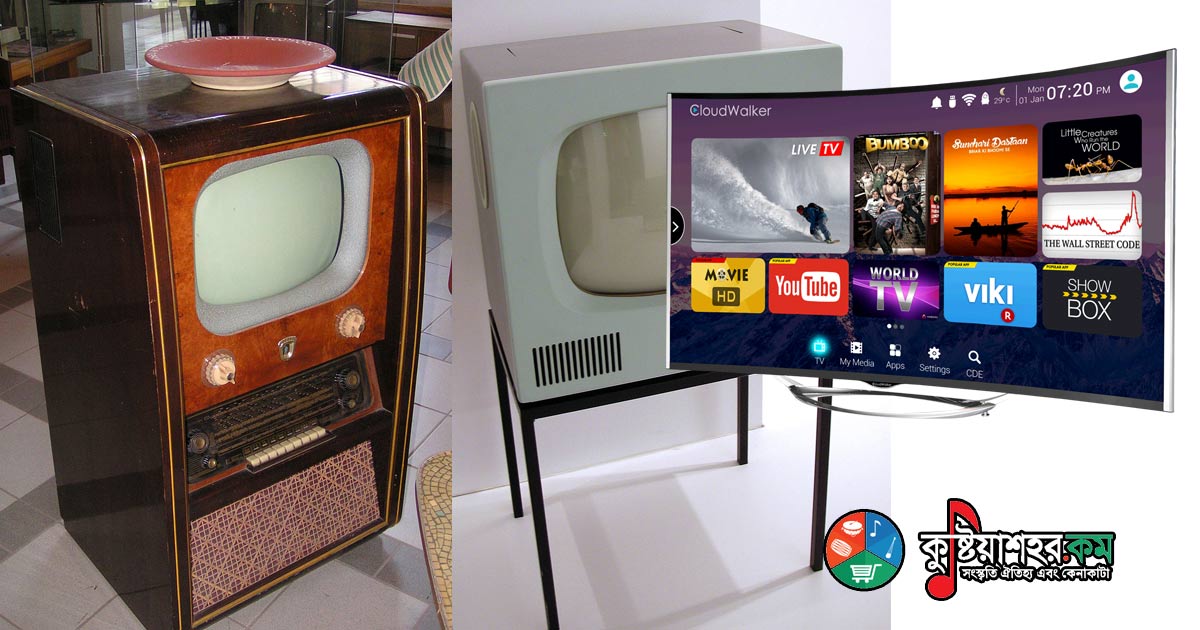
The television is a machine from which pictures can be seen and sound heard at the same time. The word television comes from English — in truth it was formed by combining the ancient Greek word τέλε (tele, meaning "far") and the Latin word Vision (meaning "sight"). That is why television is sometimes called the far-seeing machine in Bangla.
The invention
The Greek word 'tele' means distance, and the Latin word 'vision' means seeing. In 1862 it first became possible to send a still picture by wire. Then in 1873 the scientists May and Smith invented a method of sending pictures by electronic signal. The British scientist John Logie Baird invented the first television in 1926 and succeeded in sending black-and-white pictures far away by electric broadcast. Then, to the credit of the Russian-born engineer Isaac Schoenberg, the BBC began the first television broadcasts in 1936. Television started on a commercial basis in 1940, and then in 1945 the machine attained its full form. After the Second World War notable changes began in television, and in the fifties of the last century television rose to the role of a mass medium.
The broadcast technique
The core idea of television is to transmit sound and picture, as patterns, by radio waves. Television's output is created essentially by the combination of three technologies: the TV camera, whose task is to convert sound and picture into electromagnetic signals; the TV transmitter, whose task is to send those signals by radio waves; and the TV set (receiver), whose task is to receive those signals and convert them back into the original picture and sound. Generally, pictures taken by camera can be divided into two kinds: the still picture and the moving picture. An ordinary camera is used for still pictures, and a movie/video camera for moving pictures. In truth, a moving picture is created by the combination of many still pictures. A video camera takes one still picture after another in rapid succession (24 pictures per second or more). When these pictures are displayed one after another at the same speed, our eyes take them for a moving picture. The practical trick of changing pictures at this speed within the frame escapes our eyes; watch a film in very slow motion and those still pictures can be identified one by one. An analogue TV camera generally divides the pixels of these pictures into 525 lines and transmits them line by line by radio waves, while the sound wave is transmitted separately through its own signal. The TV receives the picture and sound signals through an antenna, cable or satellite and converts them back into picture and sound by a special method.
Classification of television
On the basis of display technology, televisions can be divided in various ways: CRT (Cathode Ray Tube), Plasma, LCD, LED and so on. The complete system of television, from broadcast to display, can again be divided into three: analogue television (the traditional method), digital television (DTV) and HDTV.
Analogue television
In the analogue, that is traditional, TV system, the TV camera, the transmitting system and the TV set all work by the analogue method. In such a TV, the PAL-standard picture has only 414,720 pixels (720×576), and the picture's aspect ratio is 4 : 3 — meaning the picture on the screen is 4 units wide and 3 units high. That is, on a 25-inch diagonal TV screen the picture would be 20×15 inches.