বাংলা
 English
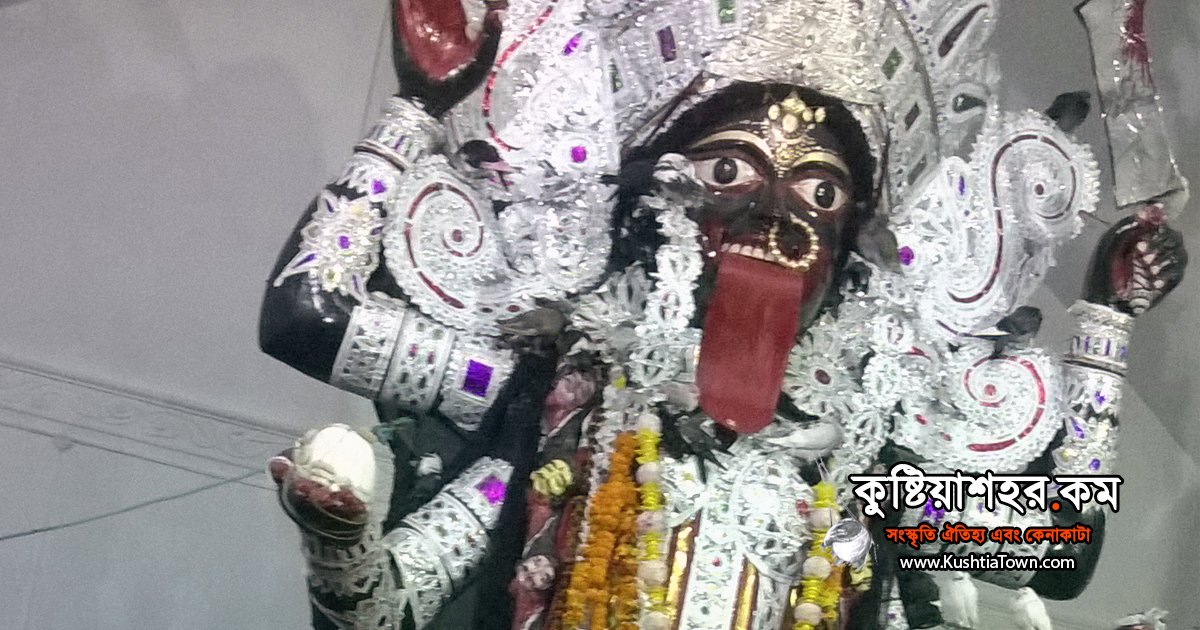
It is no longer possible today to determine when, in some remote past, Khoksa and Khoksa's Kali were born, and how, in the course of coming to know each other, they one day became one. Yet from how far mankind has advanced in this search for information, a rough idea of Khoksa thana and of this Kali Puja can be gained. For a long time Khoksa has been a thana of historic culture. Diverse cultural currents have flowed over this thana many times. As a result, Khoksa thana is at present a seat of the practice of civilization and culture.
No history of Khoksa's Kali has been found so far. No history recorded in any book or handed down through any elder's father-grandfather lore is in circulation either. What exists is not history – it is legend. Where the light of history cannot reach, one must walk in the darkness of legend. The legend of Khoksa and of Khoksa's Kali found after long research has been incorporated in the chapter "The Identity of Khoksa".
Let us discuss here some of the other legends and folk beliefs that are current about Khoksa's Kali. Sri Nripendra Krishna Bhattacharya (Dulal Thakur), the present worshipper of Khoksa's Kali, is the sixteenth lineal descendant of Ramdeb Tarkalankar, who first began this Puja. Counting 100 years to three generations (according to the reckoning of Bengali literature), the age of this Puja is about 500 years.
Ramdeb was one of two brothers: Ramdeb Tarkalankar and Mahadev Bachaspati. In course of time both these brothers performed the Kali Puja of the Raja of Naldanga. Mahadev Bachaspati, a descendant three generations down, was a famous scholar of Vani Siddhanta. He once debated for more than a month with Ramdhan Bachaspati, the renowned elderly scholar of Kashi of that time, on the scriptures of Vani Siddhanta. Vani Siddhanta was then a young man. As neither could defeat the other in this long war of debate, Vani Siddhanta, worked up, made a personal taunt at Ramdhan Bachaspati. Thereupon Ramdhan Bachaspati, blinded with rage, pronounced a curse that whichever scholar was born in Vani Siddhanta's line would die. The curse came terribly true. On Vani Siddhanta's return from Kashi, most of the scholars of his line died as if in an epidemic.
Another scholar of this line became extremely famous – the one who slew a buffalo with the Chandi. One day a fearsome, maddened buffalo attacked that scholar. To save himself the scholar flung the Chandi book from his hand, and instantly the buffalo became an offering. The Raja of Naldanga witnessed this event, and for the four branches of this Brahmin family of miraculous power, comprising 100 people, he granted 1,400 bighas of land as brahmottar. The Raja had wished to give the land as devottar, but the Brahmin family would not accept land as devottar – because devottar land can be enjoyed but not sold. The land was therefore given as brahmottar. On brahmottar land the Brahmin's absolute authority is vested.
The worshipper Nripendra Krishna Bhattacharya (Dulal Thakur) began performing this Puja from the age of 12. The worshipper's mother, Shikharbasini, did not give her son consent for the Kali Puja, because one of Dulal Thakur's brothers had died at a very young age. In Devi Shikharbasini's view, her son had died because of some fault in the Puja. Yet even so, Dulal Thakur's father, Phoni Bhattacharya, appointed his son to the Kali Puja without telling his wife. Phoni Bhattacharya passed the Adya and Madhya levels of Sanskrit, and so he kept thinking that under Ramdhan Bachaspati's curse he too would soon die. Phoni Bhattacharya's apprehension proved right: when his son Dulal Thakur was 13, he passed away. His grandfather's name was Keshab Bhattacharya and his great-grandfather's name was Chandrakant Bhattacharya. Gaurishankar Bhattacharya was the name of the elderly grandfather, and the name of the very elderly great-grandfather was simply Krishna Bhattacharya.
Jatindra Nath Bhattacharya of Kalukhali, Faridpur, gave diksha to Kabyatirtha Dulal Bhattacharya after conferring purnabhishek (full consecration) upon him. The religious belief is that if diksha is given after a purnabhishek, the Mother forgives any fault in the Puja. For at the time of the diksha Dulal Thakur's age was very small. It was therefore not impossible that some error might occur in the worship of the Mother.
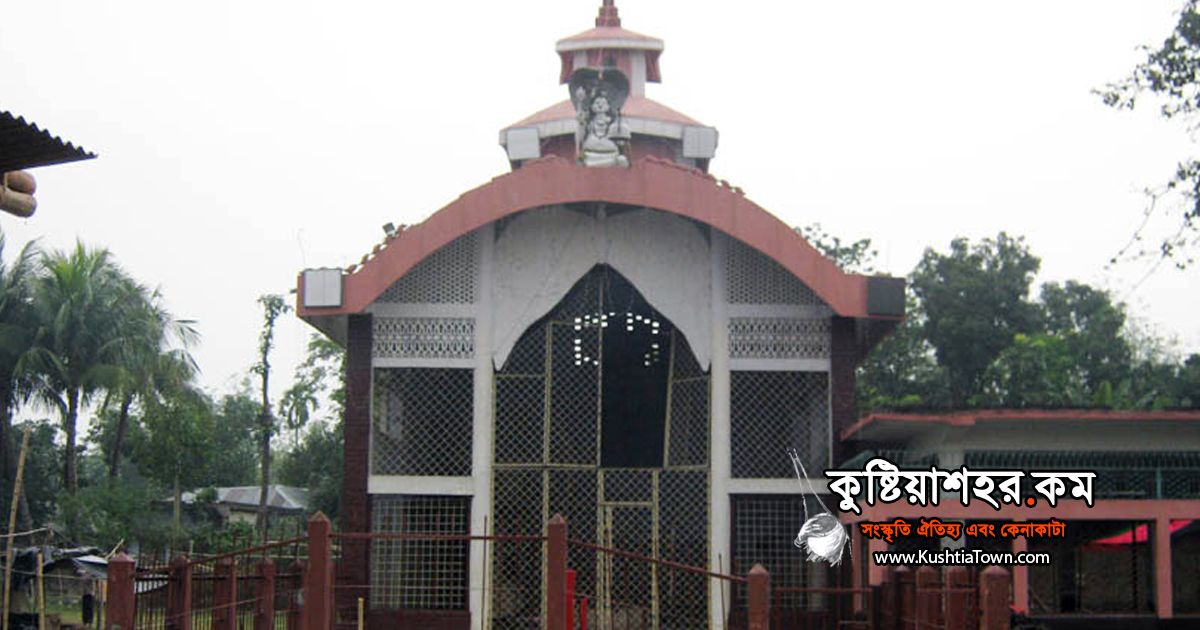
The black stone preserved in the permanent Kali temple has been discussed in the chapter "The Identity of Khoksa". Here the broken condition of the black stone may be discussed. During the time of the present worshipper's father (Phoni Bhattacharya), an earthquake demolished the temple and the black stone lay in the jungle for 7 days. Later it was sought out on a dream directive and found in a broken state. The stone still stands established on the altar. Its shape is somewhat like a four-legged chowki (square pedestal); the two feet on its eastern side and the upper foot on the western side are broken, so it has been set level with bricks. The wooden seat on which the black stone rests was given by Jadunath Singh Mahashay from his wooden arat (godown), and the larger seat was presented in 1332 by Amarendra Nath Bhattacharya Mahashay of Fadilpur in Shailkupa thana. Earlier the site of the Puja was about one furlong south-west of the present Puja temple.
The present worshipper has seen the broken remains of the ancient Puja temple. At that time the daily Puja was carried on in a temporary tin-roofed shed. During the annual festival (Maghi Amavasya) the temple was thatched with bicheli (woven bamboo matting). In 1341 the ancient Puja temple was shifted onto the land of Kutirshwar Saha, Brajanath Saha and Jadunath Singh Mahashay. When that temple collapsed into the river bed, the present temple was built in 1362 on Jadunath Singh Mahashay's land. Afterwards Jadunath Singh's three sons, Sri Sudhir Kumar Singh and Sri Sripati Kumar Singh, recorded that land in the name of Khoksa's Kali. The extent of the recorded land, that is, of the land of the temple together with the fair, is one acre and fifty shotok.
For this Puja the Raja of Naldanga granted chakran (service) land to many of the persons connected with the Puja – that is, he gave them the opportunity to enjoy land rent-free, exempted in a single payment instead of the annual rent. The duties and the amounts of land of those to whom the Raja granted chakran land are set out here.
- (a) The mason who built the frame for the annual festival enjoyed 12 bighas.
- (b) The washerman received 12 bighas for washing the Puja clothes.
- (c) The garland-maker was given 12 bighas for the flowers of the daily Puja and for the sholar and daker saaj of the annual festival.
- (d) The barber was given 12 bighas for offering flowers, lamps and incense and for supplying all the offerings. Since the barber also fetched water, he was allowed to enter the temple.
- (e) The bhuimali was given 12 bighas for such tasks as digging earth, raising the macha (platform) and laying earth at the base of the frame.
- (f) 12 bighas for the sacrifice, supplying the offerings of the daily Puja, and cleanliness and tidiness.
- (g) The dhaki (drummer) was given 12 bighas for beating the dhaak every Saturday and Tuesday.
- (h) 16 bighas was set aside for the expenses of the 108 lamps of mohur oil at the time of Dipanwita during the 7 days of the annual Puja festival and for the talbora of the month of Bhadra.
Formerly the number of sacrifices fixed for this Puja was also large. On the day of the annual Puja, the Chandi recitation was completed in the morning and one goat was sacrificed for the Chandi. At about 4 o'clock the Devi was installed on the seat. Then five goats were sacrificed for the five branches of Ratan Babu, the zamindar of Narail under the patta of the Raja of Naldanga. After that came the buffalo sacrifice sent by the Raja of Naldanga. Then, in honour of the two zamindars adjacent to Khoksa (Bhairab Babu, zamindar of Pangsha, and Thakur Babu of Shilaidaha), the pair of goats sent by them was sacrificed. Over the pair of goats there was fierce competition between the two zamindars (Bhairab Babu and Thakur Babu) over matters of honour.


Each side would arrive at the Kali Bari with a goat and 40/50 hired lathials (clubmen), beating drums. Seeing the feats of the drum-beating lathials, the public would move away in alarm. Then the two zamindars' two goats would be placed in one katala (balance) with their necks held at equal height. The zamindars' representatives would watch with an extremely sharp eye whether one goat's neck stood lower than the other's, and the moment one goat's neck was the least bit lower, that side would put up strong resistance for fear of a slight to its honour, while the lathials at once brandished their sticks and shouted to display their prowess. When the representatives of both zamindars ruled that both goats' necks had been placed level, the pair of goats was then sacrificed.