বাংলা
 English
The benefits and disadvantages of lychee
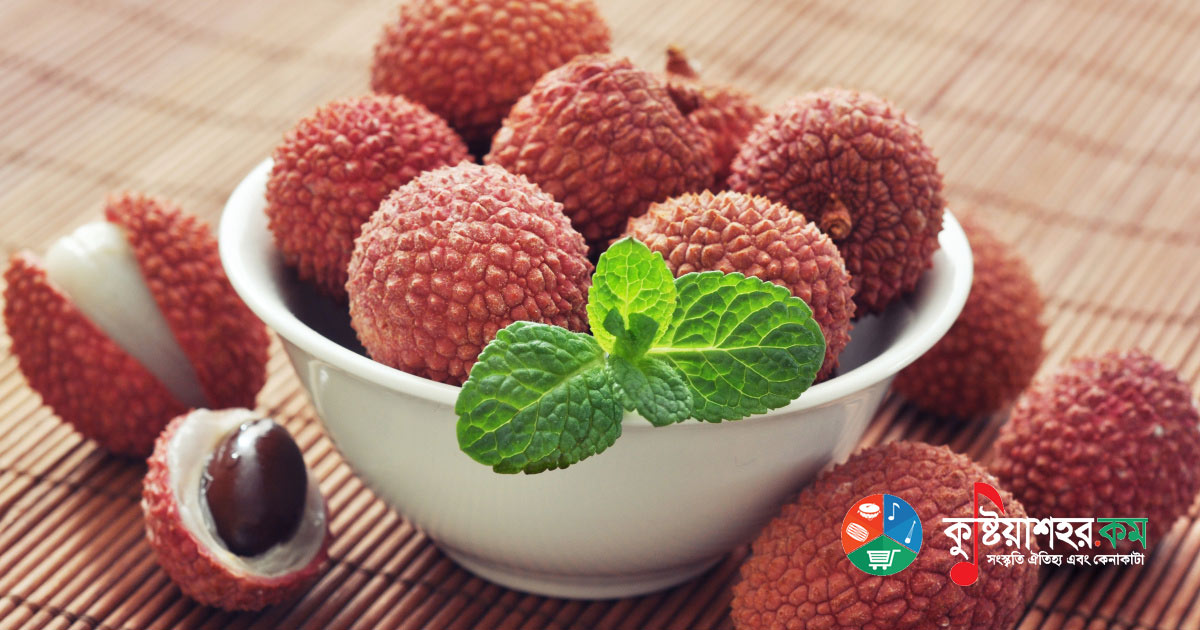
The lychee or litchi (scientific name Litchi chinensis) is a fruit of the equatorial and tropical regions. The lychee's fruit is juicy. In Bangladesh it is a summer fruit; here its blooms come in February, and the fruit generally ripens around May. Lychee grows everywhere in Bangladesh, but it yields well in the Rajshahi and Dinajpur regions of the north. This area's Mongalbaria lychee is especially popular for its large size and delicious taste.
The lychee's diameter is generally 1-1.5 inches, and the tree stands 10-35 feet tall.
The lychee is the only member of the genus Litchi of the Sapindaceae family. It grows in equatorial and sub-equatorial regions. Its original home is China. Besides Bangladesh, lychee is cultivated in many countries of the tropics and subtropics across the world, including India, Myanmar, Vietnam, the Philippines, Malaysia, Indonesia and Brazil.
The lychee holds small amounts of protein and fat, which the human body needs. Per 100 grams, the lychee holds 1.1 grams of protein and 0.2 grams of fat. Starch is found in the lychee in plenty: per 100 grams it holds 13.6 grams. Besides, the lychee holds 0.02 grams of vitamin B1 and 0.06 grams of B2, along with some amount of mineral salts — 0.5 grams of mineral salts per 100 grams.
The lychee holds vitamin C, which is good for skin, teeth and bones. Per 100 grams of lychee, 31 milligrams of vitamin C are found. Vitamin C helps cure many kinds of skin disease and scurvy; it also helps brighten the skin and reduce wrinkles. Per 100 grams of lychee there are 10 milligrams of calcium, which builds the body's bones and helps maintain their health. Iron is found in the lychee in small amounts — 0.7 milligrams per 100 grams.
Besides, the lychee holds thiamine, niacin and the like, which raise its nutritional value further. These vitamins increase the body's power of metabolism. The lychee is a good source of energy: 61 kilocalories are obtained from 100 grams of lychee. It lowers the level of cholesterol in the body and helps reduce fat alongside.
In our country many amusing things happen around the lychee — and presumably it is for that very reason that our national poet Kazi Nazrul Islam wrote the poem "Lichu Chor" (The Lychee Thief).
Lichu Chor — Kazi Nazrul Islam
In the babus' tal-pool
the lubbers' dal-kukur —
did he really live there hounded?
I say: stop, wait a while.
Near the pool, no —
there stands a lychee tree
Stealing softly, slow,
rake in hand, I go
up the tree I climbed
and gripped a little bough,
Oh dear, I stumbled, fell
down hard as well.
Where should I fall? On the gardener's neck —
he stood behind the tree, a wreck.
The brute, the rascal, shameless chap,
with a thundering clap
of fists and blows he laid on me,
full force, right in the belly.
I too panted, gasping hard,
give me air, press me with cloth —
leaping I jumped the wall,
and saw — a fox in the yard!
Oh dear, where did the fox come from
standing by the well?
At that sight, up everyone jumped,
and the dogs all ran pell-mell!
Where shall I turn, what shall I do —
the dogs will do me in, it's true!
"Oh father, oh mother!" I cried,
and slipped through the fence's broken side
into the masters' room —
my life came back with a boom!
Shall I go back? Rub my ears, brother,
if I go thieving again,
then my name is a lie!
Can one really forget, brother,
the gardener's blows —
the dog-skin stretched like that?
What do you say, next week?
Repentance — my nose in grief…!
What are the benefits of eating lychee?
- For losing weight: the lychee holds plenty of fibre and vitamin B complex, which help raise metabolism. When metabolic power is low, fat grows in the human body. The lychee plays a wonderful role in raising this metabolism, and thereby helps reduce excess body weight.
- Raising disease resistance: the lychee is an extraordinary source of vitamin C. With plenty of vitamin C alongside antioxidants, the lychee resists quite a few diseases — colds, flu, coughs. Besides, the lychee is an effective fruit for protection against various infections.
- Protection from ageing: with time, people grow old naturally. But nowadays, because of pollution, black smoke, adulterated food and many other causes, people are ageing very fast. The chief cause of age's marks appearing on the face is the free radicals produced in our bodies. The most capable of countering these free radicals is the antioxidant. A study has shown that those who eat plenty of antioxidant-rich fruits bear fewer marks of age on their faces. Since the lychee holds antioxidants in abundance, it protects the skin from the grip of ageing.
- Protection from heart disease: according to The Journal of Nutrition, the lychee holds nearly 15% polyphenols, which places it second among polyphenol-rich fruits. Among the other fruits tested, the lychee is more beneficial than the rest for keeping the heart well. The lychee lowers the body's bad cholesterol (LDL) and raises the level of good cholesterol (HDL). As a result, the heart's blood-circulation process stays right, and the risks of heart attack, stroke and hypertension fall. It is worth telling interested readers that among polyphenol-bearing fruits, first place belongs to the grape.
- Preventing constipation: because the lychee holds plenty of soluble fibre, it wards off various problems of the intestine. It also helps keep the stomach and colon clean, and so plays an effective role in preventing constipation. There is no doubt that the lychee will be very beneficial for those who have suffered constipation for a long time.
What are the disadvantages of eating lychee?
Though the lychee is quite popular as a seasonal fruit, scientists have found evidence of poisoning from lychee as the cause of children's deaths in some areas of India and Bangladesh. They say it is the cause of many children's deaths in the Indian state of Bihar and in north-western Bangladesh.
This information came up in a research paper published in a recent issue of the international medical journal The Lancet.
When several lychees are eaten on an empty stomach, the poison formed in the body brings on sudden convulsions and vomiting in healthy, hearty children — and then they fall unconscious. More than half of the children stricken this way die.
Until now, in Bihar the 'lychee disease', or in places in Bangladesh 'the use of some unknown pesticide', was held to be the cause of these child deaths. But now it appears the cause of death was hidden within the lychee fruit itself.
The lychee holds a chemical called hypoglycin, which blocks the body from making sugar. When children eat too many lychees on an empty stomach, the amount of sugar in their bodies falls so low that it becomes the cause of death.
In the Bihar case, scientists examined each child's medical records closely and concluded that those children had eaten nothing the night before, or eaten little; the next day they had eaten many fallen, spoilt or unripe lychees together — and then the children fell ill.
The lychee's harvest falls between May and July, and it is in exactly that season that children die most with those symptoms.
Scientists say it was known long ago, from research in the Caribbean islands, that many children die of the poisoning caused by eating unripe lychees or lychee-like fruits.
Then detailed information about that disease, named 'Jamaican Vomiting Sickness', reached India and Bangladesh and several other regions of Asia much too late, says The Lancet.