বাংলা
 English
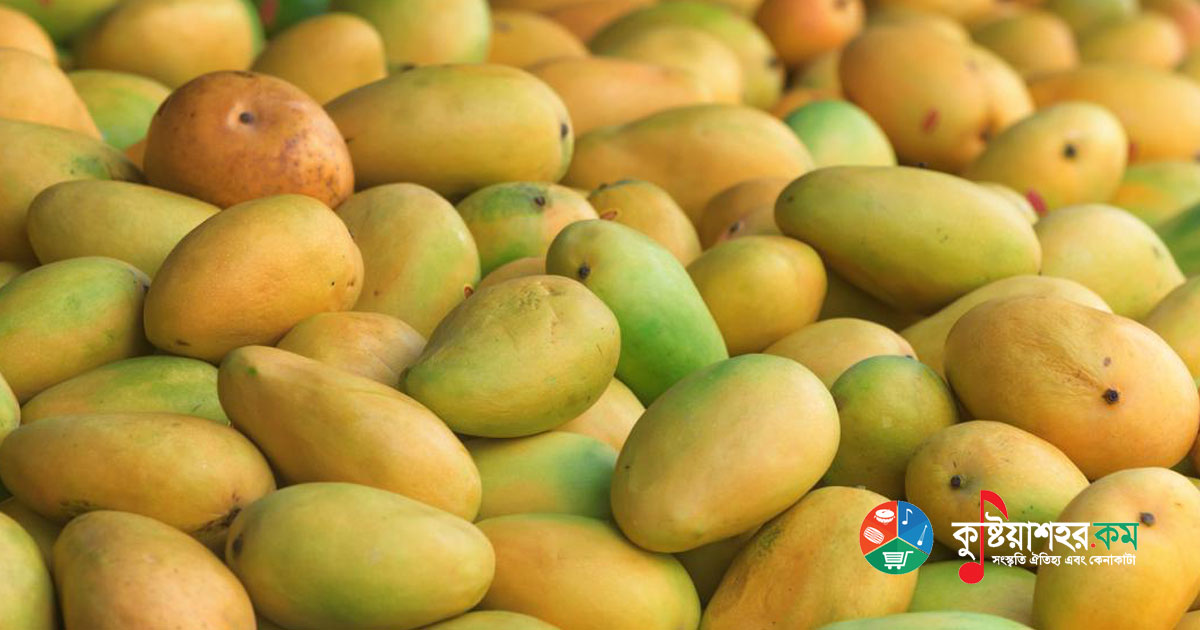
The mango (Mango) is a fruit grown widely in the tropical and subtropical countries. The origin of this fruit tree, Mangifera indica of the Anacardiaceae family, is very ancient. According to some experts, the mango is native to the eastern part of the Indian subcontinent, including Bangladesh, Assam (India) and Myanmar. The origin of other species, such as M. laurina, is probably in the Malay region. There are about 35 species of mango in the world.
Among the fruits used in India's various religious and folk ceremonies, the mango is used the most. Very few fruits are as inseparably bound to such ceremonies as the mango. It is said that Gautama Buddha himself was gifted an amrakanan — a mango grove — so that he might rest in its shade. In ancient times, to convey the mango's worth and importance, it was named aam in Sanskrit, meaning stored food or provisions. The famous Chinese traveller Hiuen Tsang visited India around 632 to 645 AD, and it is thought that he was the first to introduce the mango to the world outside. The Mughal emperor Akbar, during his reign (1556-1605 AD), planted nearly a hundred thousand mango trees near Darbhanga at Lakhbagh in India. It is regarded as the Indian subcontinent's first organised mango orchard.
In Bangladesh the mango is a popular fruit. For many years these odd names of the mango have carried an air of nobility, and behind every mango's name lies a history. Let us learn the reason for such names.
The Fazli mango: It is known that in 1800 an old woman named Fazli Bibi lived in an ancient kuthi of Gaur. In the courtyard of her house stood a mango tree, and she took great care of it. The collector of that area, Rajbvensh, once set up camp near the old woman's house. Hearing news of his arrival, the old woman met him with those mangoes.
Rajbvensh ate those mangoes and took great delight in them, and asked the name of the mango. But not understanding English, hearing only 'name', Fazli Bibi said her own name. From that day the mango was called 'Fazli'.
Fazli, or Fakirbhog, is a variety of the seasonal mango. This fruit is found in eastern South Asia, especially in Bangladesh and India's West Bengal and Bihar. This crop ripens later than other varieties of mango. Fazli, generally used for making jam and pickle, is quite large — it can weigh a kilogram or more. Malda district in India's West Bengal state and the Rajshahi and Chapainawabganj districts of northern Bangladesh are famous for growing Fazli.
Between April 2008 and March 2009, India obtained a geographical indication in the World Trade Organization for Malda district's Fazli mango. Bangladesh too began thinking in 2013 of obtaining a geographical indication for Rajshahi's Fazli.
The Langra mango: This mango began to be cultivated in Darbhanga in the Mughal era, but at that time no one troubled over its name. Later, in the eighteenth century, a faqir cultivated this very tasty mango. That faqir had something wrong with his foot (langra means lame), and from that, so it is said, the mango came to be called 'Langra'.
The Langra mango, or the Banarasi mango, is one of India's most famous mangoes. It is cultivated across northern India including West Bengal. When ripe, this mango takes on a somewhat yellowish colour. It begins to ripen and appear in the market around July. It is considered ideal for cutting into small pieces, and is also considered ideal for the many foods made from mangoes.
The Lakhanbhog mango: in the British era, Lakshman, a resident of Chandipur in the English Bazar area, planted a mango tree. In taste and scent that mango was unmatched. From the name of the farmer Lakshman came the origin of the Lakhanbhog mango.
The Gopalbhog mango: a man named Gopal of Norhatta in English Bazar cultivated this mango; from the farmer Gopal's name came the origin of Gopalbhog.
The Golapkhas mango: this mango is famous for its scent. Because it smells like the rose flower, this mango began to be called Golapkhas. It is one of the ancient mangoes of Bengal, and its skin carries a reddish tinge of rose colour.
The Guti mango: a poor farmer of Malda ate a small kind of mango and planted its stone in his own garden. From that stone a mango tree was born. Sour when raw, but very sweet when ripe — because the tree was born from a stone or guti, the mango too was named 'Guti'.
The Ashwina mango: the mango that ripens in the month of Ashwin is called 'Ashwina'. Mangoes of the Ashwina variety generally stay on the tree until August; in some areas this mango can be found in the first week of September too.
The Dasheri mango: the history of the royal household is bound up with the mangoes of Uttar Pradesh. Take, for instance, the Dasheri, the king of mangoes. About 25 kilometres beyond Lucknow, the capital of Uttar Pradesh, lies a place called Malihabad. This area is known for the superior Dasheri mango. Mango orchards spread over 35 thousand hectares of land here; 12.5 per cent of the state's total mango harvest grows in this Malihabad itself. That is why Malihabad is called 'the mango capital'.
According to the local people, though, there are many tales about Malihabad and the Dasheri mango. Some say that about 200 years ago, led by Faqir Mohammad Khan alias Goya Malihabadi, a band of Afridi Pathans, in quest of fortune, came from a village on the Khyber Pass at Afghanistan's border, through Peshawar, into Hindustan. They came first to Farrukhabad in Uttar Pradesh, and from there to Awadh-Lucknow. Seeing Mohammad Khan's valour and mastery of the art of war, the Nawab of Awadh was pleased. As a reward, Mohammad Khan asked the Nawab Bahadur for permission to plant orchards of fruit, and it was granted at once. It is said that Mohammad Khan planted the first mango saplings in Malihabad.
But at one time the Dasheri mango orchards all belonged to the nawabs; later they were leased out to others. The fame of Bengal's mangoes at one time belonged to the nawab era of Murshidabad.
Amrapali: many know the Amrapali mango as 'Aamrupali'. In truth this mango's real name is Amrapali. Researchers of India created one of the world's astonishing mangoes — this is that Amrapali. The name of India's greatest dancer was Amrapali.
In 1978 India's mango researchers created the Amrapali variety by hybridising two mangoes, Dasheri and Neelum. This variety has quite a few characteristics. Firstly, because of our country's climate, improved varieties fruit on a tree one year and not the next — but the Amrapali fruits every year. Its sweetness is greater than that of the Langra or the Himsagar. The tree is dwarf in shape, and the yield is high. At a spacing of five hands, one thousand five hundred Amrapali saplings can be planted in one hectare of land. The mango is elongated in shape and ripens in the month of Asharh. Its average sweetness is more than 23 per cent. The stone is narrow, the flesh tasty and fibreless. The first Amrapali saplings came to our country in 1990. Nowadays Amrapali saplings can be bought in the country for 30 to 50 taka. There are very large Amrapali orchards in the districts of Jessore, Satkhira, Chuadanga, Meherpur, Jhenaidah, Narail and Magura. Besides, Amrapali is now cultivated in abundance in the hill districts too. Sixteen metric tons of Amrapali grow per hectare. The Amrapali is somewhat like a vegetable: it needs plenty of fertiliser every year. When the tree is 12-14 years old, it is better to cut it down and plant new saplings — the reason is that the fruit of an aged Amrapali tree grows small and its yield falls. The Amrapali is a mango of incomparable sweetness; its colour and scent are wonderful. This mango is somewhat long and small in size. The Aamrupali weighs from 75 grams to 300 grams. This low-fibre mango has thin skin and a thin stone. The Amrapali generally comes after the Fazli mango.
The Haribhanga mango: in the orchard of the zamindar's house in the Balua Masimpur Union, in the time of the people-loving, generous and connoisseur king Taj Bahadur Sing, there was a garden of various imported species of fragrant flowers and tasty fruits — which was swallowed into the bed of the Jamuneshwari river in the flood and erosion of 1988. The late Nofal Uddin Paikar of Tekani village in Union No. 1 Khoragach, son of the late Tamir Uddin Paikar, was in the mango business. He sold the mangoes of the zamindar's garden and other mango growers in various haats, including the Poda Ganj. Among the imported mangoes of the zamindar's garden there was one that was extremely tasty, sweet and beautiful to look at, so he took a graft (a sapling) of it and planted it in his own land. As the land was of Barind nature, to make it easy to water the tree's base in the dry season, he set a pot (hari) at its foot and arranged irrigation by the filter method; but within a short while, someone or other smashed that pot. In the course of time the tree became a fruit-bearing tree. When Nofal Uddin's neighbours, friends and consumers ate the mangoes of that tree and asked him about the source of such a tasty mango, he said: whoever it was that smashed the tree's pot, this is the mango of that very tree. Following the word Haribhanga (pot-smashed) spoken by Nofal Uddin to identify the tree, it later came to be known as 'Haribhanga'.
The Haribhanga mango tree's appearance is striking and attractive. Its top or crown is well-fed and stout. A tree made by grafting from its crown, or by side-grafting a branch, grows extremely fast; within a short time its branches spread and the tree's girth grows notably. Blooms come the very year after planting the sapling; but if the first year's blooms are broken off, the tree's crown grows in number and becomes stout. One of the Haribhanga mango tree's chief characteristics is that its branches, rather than growing upward or skyward, are seen to spread more to the sides. As a result its height stays low, so the tree is not uprooted in storms, and fewer mangoes fall in the wind. The mango's upper part is quite thick and broad, the lower part comparatively slim. The mango looks stout and fleshy; the stone is round and somewhat long. Compared with the mango the stone is much smaller, and there is no fibre within. In weight it is heavier than other mangoes of the same size — three mangoes average a kilogram; in some cases a single mango weighs 500/700 grams. A well-fed mango stays intact a long time: the skin may shrivel, yet it does not rot. From small to ripe, a different taste is found at each stage — though it is best not to let the mango ripen too much.
Besides these, there are mangoes of many other names whose exact naming histories we do not know. The search continues — if you know the exact history of any of these mangoes' names, you can tell us and we will present it to the world. For example: Khirsa, Aruna, Mallika, Subarnorekha, Mishridana, Nilambari, Kalibhog, Kachcha Mitha, Alphonso, Baromasi, Tota Puri, Karabau, Keitt Sauyi, Golap Khas, Kent, Surjopuri, Pahutan, Trifala, Chhatapora, Guthli, Lakhna, Adaira, Kalabati, and so on.
Varieties of mango (cultivars)
- Fazli
- Ashwina
- Khirmohan
- Sendura Guti
- Langra
- Gourmoti
- Gopalbhog
- Modhu Chushki
- Brindaboni
- Lakhna
- Tota Puri (Matras)
- Rani Pachond
- Khirsapat
- Amrapali
- Himsagar
- Batasa
- Khudi Khirsa
- Bombai
- Surma Fazli
- Sundori
- Baishakhi
- Iyar Chara
- Roski Jahan
- Hiralal Bombai
- Okrang
- Malda
- Sheridhon
- Shamsul Samar
- Badsha
- Ros ki Gulistan
- Kandmukarrar
- Nam Doc Mai
- Bombai (Chapai)
- Calenda
- Ruby
- Bogla
- Mulgova
- Himsagar Rajshahi
- Kalua (Natore)
- Chousa Lucknow
- Seedless
- Kalibhog
- Badshabhog
- Krishnakoli
- Patnai
- Guti Lakhonbhog
- Bagan Bilas
- Guti Langra
- Paturia
- Pulsar
- Amina
- Kakatua
- Chalita Guti
- Rang Bhila
- Buddho Kalua
- Rajlakkhi
- Madhuri
- Bangalora
- Bon Khasa
- Parija
- Chandonkhos
- Dudh Kumari
- Chhatapora
- Chosa
- Jilapi Kara
- Sital Pati
- Pujari Bhog
- Jagat Mohini
- Dilsad
- Bishwanath Chatterjee
- Begum Bahar
- Raja Bhulani
- Nabi Bombai
- Sindi
- Bhuto Bombai
- Golek
- BARI Aam-7
- Kali Bombai
- Chokchoka
- Peyara Fuli
- Valenato
- Sinduri Fazli
- Ambra
- Gulabjamun
- Alam Shahi
- Australian Mango
- Maya
- Dadabhog
- Sharbati Brown
- Alphan
- Ratna
- Laddu Sandila
- Chhoti Bombai
- Kalijongi
- Dwarika Fazli
- Mithua
- Bombay Sayah
- Bombay Green
- Tohfa
- Kachcha Mitha Malihabad
- Taimuriya
- Jahangir
- Kawashji Patel
- Nosha
- Jalibam
- Bagan Palli
- Bharatbhog
- Fazri Kolon
- Sabina
- Sen Session
- Lota Bombai
- Allampur Baneshan
- AR-2 F-2
- Shraboni
- Imam Pachond
- Jonardon Pachond
- Krishnabhog
- Saruli
- Ilshe Peti
- Kolom Baji
- Yakutia
- Guti
- Bhujahajri
- Matraj
- Samar Bahisht Alibag
- Golapbas
- Juli
- Vejpuri
- Kalua Gopalbhog
- Kolom Sundori
- Banaraj
- Madam Francis
- Mixed Special
- Mohammad Wala
- Safeda Malihabad
- Khan Bilas
- Zafran
- Modhu Malti
- Jitubhog
- Polokpuri
- Kakrahia Sikri
- Pathuria
- Bombay Kolon
- Kensington
- Kakrahan
- Mishri Dumdum
- Samar Bahisht
- Manzanillo Nunez
- Najukbodon
- Farukbhog
- Rumani
- Terpentine
- Kensington
- Kakrahan
- Mishri Dumdum
- Samar Bahisht
- Manzanillo Nunez
- Najukbodon
- Farukbhog
- Rumani
- Terpentine
- Kumra Jali
- Dudiya
- Maharaj Pachond
- Manila
- Piyari
- Jan Mahmud
- Samar Bahisht Rampur
- Madu
- La Jabab Malihabad
- Laili Alupur
- Neelam
- Mishribhog
- Padmodhu
- Bangamuri
- Punit (Hybrid-13)
- Belkhas
- Sridhon
- Aman Khurd Bulandbagh
- Palmer
- Karabau
- Ameli
- Korakao De Boi
- Nisar Pachond
- Pahutan
- Borron
- Hindi
- Safeda Badshabagh
- Rad
- Aramanis
- Bangla Wala
- Mombasa
- Rosa
- Cambodiana
- Fazri Zafrani
- Bombaikhurd
- Extrema
- Badrol Asmar
- Shadwala
- Samar Bahisht Karana
- Espada
- Bashi Bombai
- Karpura
- Husne Ara
- Safeda Lucknow
- Shadulla
- Aziz Pachond
- Karpuri Bhog
- Jil
- Sarohi
- Glen
- Tommy Atkinson
- Sam-ru-Du
- Mabroka
- Himauddin
- Florida
- Keitt
- Irwin
- Naomi
- Kent
- Tom Atkins
- Alphonso
- Narikel Phanki
- Jamai Pachond
- Lakhonbhog
- Bhaduria Kalua
- Chini Fazli
- Mallika
- Surjopuri
- Hayati
- Pauthan
- Dudhswar
- Golap Khas
- Benarasi Langra
- Patnamjathi
- Jalibanda
- Mishridana
- Nak Fazli
- Subornorekha
- Kala Pahar
- BARI Aam-2
- Bou Bhulani
- Jamrud
- Aruna (Hybrid-10)
- Nilambari
- Fonia
- Chousa
- Diabetic Mango
- Sindhu
- Bogla Guti
- Rajbhog
- Dudhswar (small)
- Mohon Bhog
- Haribhanga
- Tikka Farash
- Amrapali (large)
- Himsagar (Natore)
- Mouchak
- Mohanonda
- Tota Puri
- BAU Aam-3
- BARI-3
- Pukur Par
- Kohitur
- Bilu Pachond
- Kagri
- Chinibasa
- Dudh Kumar
- Monda
- Laddu
- Sitabhog
- Shova Pachond
- Grithadagi
- Chhoto Ashwina
- Jhumka
- Dussehri
- Kali Bhog
- Bhabani Charush
- Alfaz Bombai
- Modhumoni
- Mishrikanto
- Giradagi
- Kua Pahari
- Bira
- Darbhanga
- BARI Aam-4
- Arajam
- Govind Bhog
- Kachcha Mitha
- Motimonda
- Polladagi
- Dadbhog
- Shyamlota
- Mishridagi
- Kisan Bhog
- Bharati
- Baromasi
- Deobhog
- BARI-8
- Amrapali (small)
- Siddik Pachond
- Lota
- Badami
- Anarosh (Pineapple)
- Jahuri
- Rakhal Bhog
- Guti Malda
- BARI Aam-6
- Rogoni
- Baunilota
- Gourjit
- Begum Fuli
- Appus
- Fazrigola
- Safeda
- Anowar Rataul
- Babui Jhangi
- Monohara
- Rangowai
- Golla
- Kazi Pachond
- Rangamuri
- Boro Babu
- Korolla
- Jalikhas
- Kalia
- Satiarkora
- Safdar Pachond
- Chunchamukhi
- BARI Aam-5
- Kader Pachond
- FTIP BAU Aam-4
- Dillir Laduya
- Tiyakati
- FTIP BAU Aam-9 (Shoukhin Choufla)
- FTIP BAU Aam-1 (Shraboni-1)
- FTIP BAU Aam-7 (Polyembryony-2)
- FTIP BAU Aam-2 (Sinduri)
- FTIP BAU Aam-10 (Shoukhin-2)
- FTIP BAU Aam-3 (Diabetic)
- FTIP BAU Aam-8 (Polyembryony-Rangowai-3)
- FTIP BAU Aam-11 (Kachcha Mitha-1)
- FTIP BAU Aam-6 (Polyembryony-1)
- FTIP BAU Aam-12 (Kachcha Mitha-2)
- FTIP BAU Aam-13 (Kachcha Mitha-3)
- FTIP BAU Aam-5 (Shraboni-2)