বাংলা
 English
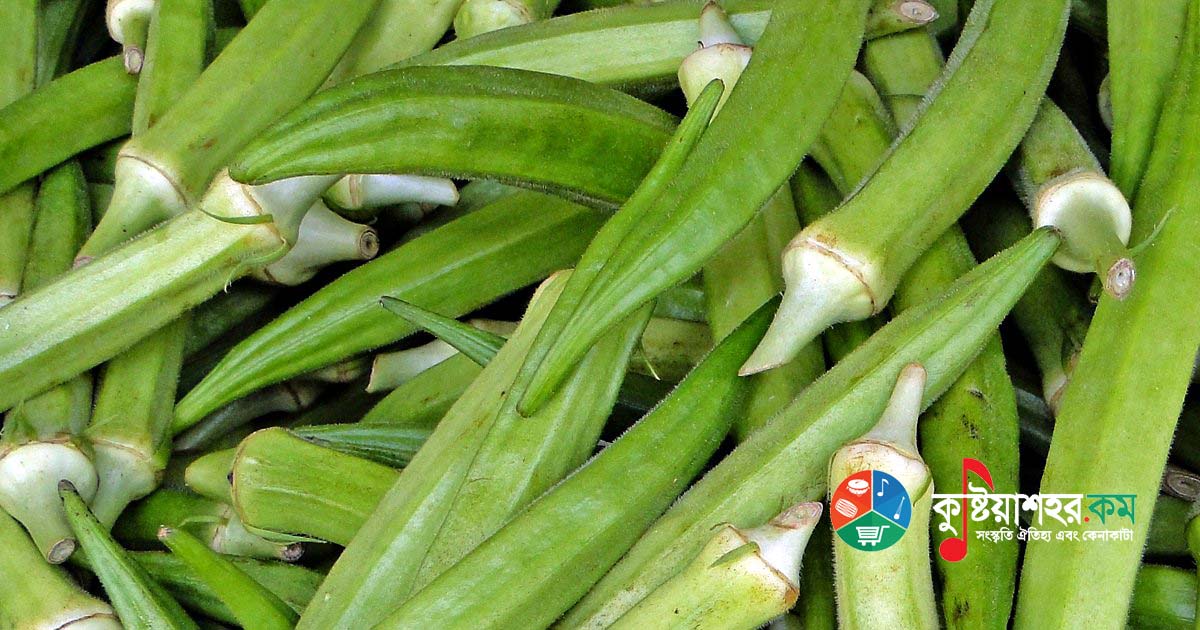
Okra (also called lady's finger) is a kind of flowering plant of the mallow family. It is related to cotton, cocoa and hibiscus. The raw fruit of the okra plant is eaten as a vegetable. Okra's scientific name is Abelmoschus esculentus, or Hibiscus esculentus.
The okra plant is an annual plant that grows up to 2 metres tall. Its leaves are 10–20 cm long and broad, with 5–7 lobes. The flowers are 4–8 cm wide, their petals whitish yellow, five in number, each petal bearing a red or pink spot at its centre. The okra fruit is capsule-shaped, nearly 18 cm long, and holds countless seeds within.
Okra's original home was the highland regions of Ethiopia. How it spread elsewhere from there is not known. In various writings of the Egyptians and the Moors, okra finds mention in Arabic in the twelfth and thirteenth centuries — from which one may suppose that it came there from the East. Presumably it travelled from Ethiopia across the Red Sea or the Bab-al-Mandab Strait near the Arabian Peninsula to Arabia, and later to Europe. In 1216 it finds mention in the writing of a Spanish Moor, who noted during his travels in Egypt that the local people ate okra's fruit mixed with flour.
From Arabia, okra spread to the countries along the Mediterranean, and later eastwards. Its name finds no mention in the ancient languages of the Indian subcontinent, from which one may suppose that this plant arrived there only after the birth of Christ. Okra came to the American continent through the ships that travelled in the Atlantic Ocean's slave trade. Its presence in Brazil is recorded by around 1658, and by around 1686 it had reached Suriname.
In North America, especially the south-east, okra arrived in the early eighteenth century. In 1748 it was being cultivated as far north as the Philadelphia area. Thomas Jefferson's writings record that in 1781 okra was being cultivated widely in Virginia.
The benefits of okra:
Okra contains vitamin A, fibre and antioxidants, so okra raises disease resistance. Okra holds many medicinal qualities that prevent breathlessness. It carries a special element called pectin, which helps reduce bad cholesterol in the blood, and thereby prevents the complex disease called atherosclerosis.
Okra helps build the foetus's brain during pregnancy, and this vegetable prevents miscarriage. Okra removes toxic substances from the skin and helps rebuild the body's tissues and clear away acne. Okra contains vitamin C, anti-inflammatory and antioxidant elements.
Okra is quite beneficial in preventing asthma and protecting against asthma attacks. Okra reduces the risk of colon cancer. Okra helps remove depression, weakness and fatigue. Okra holds beta-carotene, vitamin A, antioxidants and lutein, which help prevent glaucoma and cataracts of the eye.
Okra builds resistance against harmful free radicals; it contains vitamin C and antioxidants. Okra holds essential minerals such as calcium, magnesium and manganese, which raise disease resistance.
Okra contains a high amount of fibre, which helps digestion. Pectin reduces swelling of the intestines and clears waste easily from the gut. Okra works quite well as a hair conditioner: it removes dandruff and is beneficial for dry scalps.