বাংলা
 English
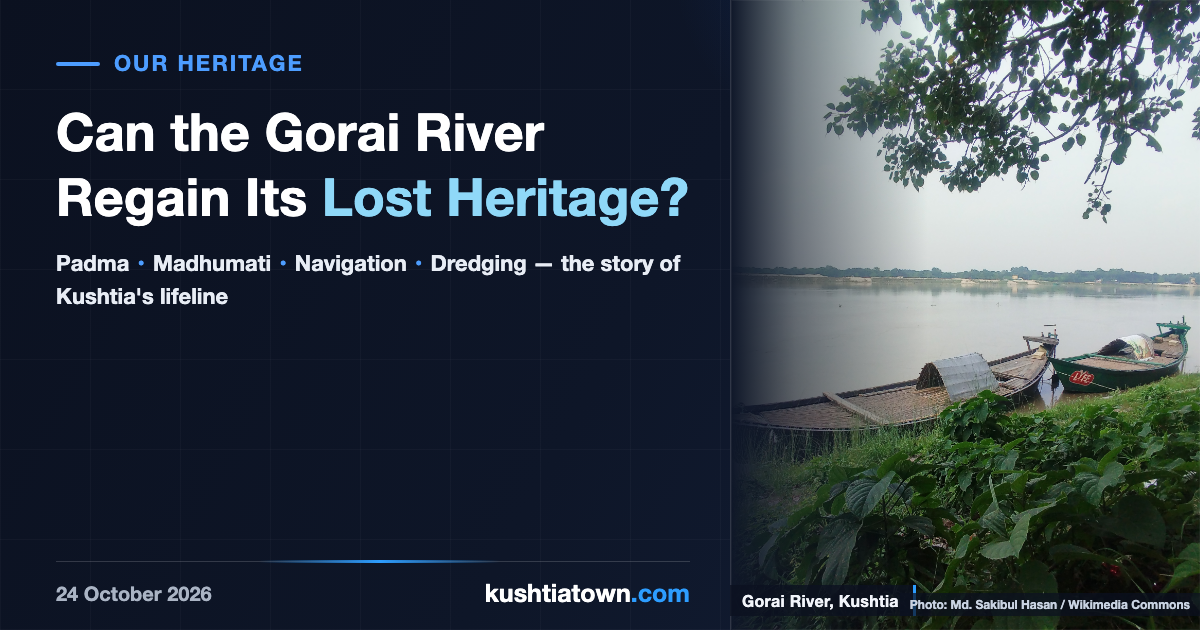
Rivers of Bengal are more than streams of water; around them grew towns, agriculture, trade, literature, music and people's way of life. Rivers gave people livelihoods, fertile land, fish, routes of travel and an intimate bond with nature. And when a river's flow changes, the economy, environment and lives of an entire region change with it.
The Gorai River of Kushtia is one such river. Originating from the Padma, this river once played a vital role in the water flow, agriculture, fisheries and environment of the south-western region. Settlements, farmland, ghats and various towns grew up along the banks of the Gorai. The river is intertwined with Kushtia's history, literature and cultural identity.
But over time, the face of the Gorai has changed. Reduced dry-season flows in different stretches, shrinking navigability from accumulated sand and silt, and the long-standing problem of water entering the river's offtake have been causes of concern for years. Although dredging projects have been undertaken at various times to restore the river, the challenge of permanently maintaining a normal flow remains.
News reports published in 2024 and 2026 have also raised questions about the Gorai's navigability crisis and the effectiveness of the dredging projects. So the important question today is—can the Gorai River regain its lost heritage? Answering it requires understanding the river's history, its present crisis and the prospects of restoration together.
The Gorai: Identity and Geographic Importance
The Gorai is an important distributary of the Padma. It originates from the Padma near Talbaria in Hatsh Haripur union of Kushtia district—about 19 kilometres downstream of the Hardinge Bridge. The river then flows through Kushtia, enters Jhenaidah district near Ganeshpur, and, according to official local sources, finally merges with the Madhumati River near Nakol union of Sreepur upazila in Magura district. According to the Bangladesh Sangbad Sangstha (BSS), the river is about 89 kilometres long.
According to the Kushtia district administration's information portal, it is also believed that the main stream of the Ganges once flowed through the Gorai, although the Hooghly-Bhagirathi was the Ganges' original channel. That history of shifting courses shows just how dynamic and changeable a river the Gorai is.
The Gorai's relationship with the river system and environment of the south-western region is extremely important. Its flow influences agriculture, aquatic habitats, groundwater recharge and the livelihoods of riverside communities.
The Gorai's importance is not confined to Kushtia district. Its flow is tied to the wider hydrology of the south-west. According to a BSS report, the river's freshwater flow is the main source of fresh water protecting the environment and biodiversity of ten south-western districts—agriculture, fisheries and waterways included—and keeping the Sundarbans, the protected mangrove forest of the Khulna coast, safe from salinity intrusion. The daily Inqilab's report likewise noted that the lives and livelihoods of some 50 million people in this region are tied to this river system. Maintaining an adequate freshwater flow is therefore crucial to the region's ecological balance.
Keeping a river like the Gorai flowing is not just about removing sand from its middle reaches. The entry point of water from the Padma, the elevation of the riverbed, sediment transport, wet- and dry-season flows, and the surrounding water systems must all be considered together.
Source: Kushtia District Administration — Rivers
There Was a Time When the Gorai Was Part of Life
To understand the Gorai's past, one has to look at the relationship between the river and its towns. The river's water was tied to farmland, fish, river transport and a variety of livelihoods. Its influence on the daily life of riverside people was profound.
In the monsoon the river would swell, water and silt would spread over the banks, and habitats for aquatic life would expand. People connected to the river earned their living by fishing, boating, farming and local trade.
Yet in discussing the river's past, one thing must be remembered—the river's water, depth and flow were not the same in every season. Its face naturally changed between the monsoon and the dry season. Understanding today's crisis therefore requires not only memories of the past but also long-term flow data, knowledge of how the riverbed has changed, and scientific observation.
Still, the Gorai that survives in the memory of the elderly helps us grasp the river's social and economic significance. When the flow of a river around which people's work, travel and livelihoods once revolved diminishes, that way of life feels the impact too.
The Gorai and the Padma in Tagore's Memory
The relationship between Kushtia's literary heritage and the Padma-Gorai rivers deserves special mention. Rabindranath Tagore, during his time at Shilaidaha, drew deep inspiration from the Padma and the surrounding nature. Rivers, boats, rural people, nature and the life of Bengal found their way into his works in many forms.
The riverine world of Shilaidaha and Kushtia is central to the story of Tagore's life and creativity. The wide floodplains, chars and villages of the Gorai-Padma, and the changing nature around them, are part of this region's cultural identity.
Reading Tagore, one cannot see the river as a mere geographical feature; the river becomes an emblem of human feeling, of nature's change, and of rural life. In that sense, preserving the Gorai's heritage means not only bringing back its water, but also caring for the history and cultural memory of its riverine towns.
That said, before claiming any specific poem or prose of Tagore mentions the Gorai, the relevant works and reliable sources must be verified. The regional link between the Gorai and the memories of the Padma and Shilaidaha, and a direct mention of the Gorai in a specific work, are two different things.
Why Is the Gorai Losing Its Navigability?
Chief among the river's present troubles are the dwindling dry-season flow and the loss of navigability as sand and silt accumulate in different stretches.
A report published by Ekhon TV on 19 March 2024 said that in the dry season, roughly a 14-kilometre stretch from the Gorai's offtake in the Kushtia region had dried into a dead canal. The report also noted that when the Padma's water level drops in the dry season, a vast sandbar forms at the Gorai's mouth, cutting off the freshwater flow. It voiced concern over unplanned dredging and the lack of sustainable planning.
Another report by Independent Television, published on 27 April 2026, highlighted the river's navigability crisis, the limits of the dredging project, and the impact on agriculture and the environment.
In light of these reports, several key aspects of the Gorai's crisis can be discussed.
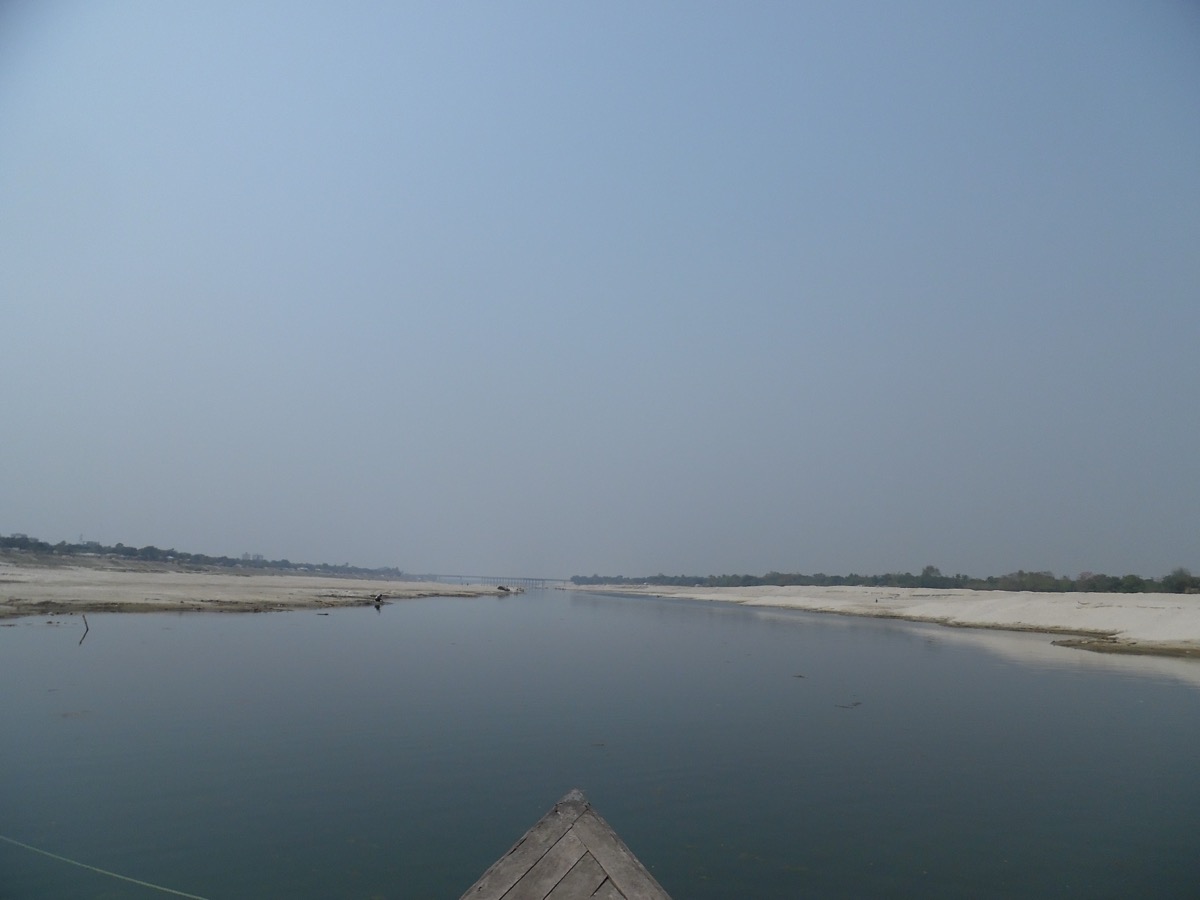
Sandbars lining the Gorai in the dry season, Ghoraghat area, Kushtia. Photo: Salim Khandoker / Wikimedia Commons, CC BY-SA 4.0
1. The Problem of Water Entering from the Padma
The Gorai's flow is directly tied to the Padma. If enough water does not enter the Gorai's offtake from the Padma, dredging the riverbed alone cannot ensure a normal flow year-round.
When silt and sand shrink the water's entry channel at the offtake, the river's flow can be obstructed. Restoring the Gorai therefore demands special attention to the entry path from the Padma.
2. Accumulation of Silt and Sand
Rivers naturally transport sediment. Where silt settles and where it moves on depends on flow velocity, water volume, the shape of the bed and the surrounding terrain.
When silt and sand build up in a reach and the river's depth falls, the channel for water can narrow. But determining how much sediment has settled where, and where it comes from, requires regular surveys and scientific analysis.
3. Water Scarcity in the Dry Season
Although the river holds water in the monsoon, the dry-season decline has long been a worry for the Gorai. When water falls in different stretches during this period, aquatic habitats can shrink, pressure can build on agriculture and local livelihoods, and dependence on groundwater can grow.
4. The Durability of Dredging
Dredging may be needed to restore navigability. But dredging alone offers no guarantee that the river's flow will stay normal over the long term.
If the problem of water entering at the offtake remains unresolved, or sedimentation continues, the benefits of dredging may fade within a short time. Dredging should therefore be implemented not as a stand-alone project but as part of a broader river-management plan.
Read more: Ekhon TV — The Gorai has lost its navigability; dredging still brings no lasting solution
What Happens When the Gorai Dries Up?
The impact of a failing flow is not confined to the middle of the river. The river and its surroundings are bound in a mutual relationship; when that bond weakens, agriculture, biodiversity, fisheries and people's daily lives can all change.
Agriculture and Irrigation
The Gorai's flow is linked to riverside agriculture and irrigation. When the river runs short of water, irrigation systems can come under strain. But to know the real cause of any water shortfall in a given scheme, river flow, pump performance and irrigation data must be analysed together.
A BSS report of 23 May 2024 raised concern over the river's water crisis and its links to agriculture, biodiversity and the operation of the GK irrigation pump. According to the report, the GK pump's breakdown left riverside farming under threat; and it is precisely to sustain native fish production, keep the GK pump running, keep the Sundarbans free of salinity and hold the groundwater level that the government strives to keep the Gorai navigable year-round.
Pressure on Groundwater
In many places river water and groundwater exchange naturally. The relationship between the river's stage and the surrounding water table varies from place to place.
Alongside the Gorai's shrinking flow, there have been periodic reports from the Kushtia region of tube wells failing and the water table falling. How much of a direct causal link exists among these problems, however, requires geological and hydrological data to determine.
Fish and Biodiversity
When a river's water recedes, the living space of fish and other aquatic creatures can shrink. Depth, temperature, dissolved oxygen and changes in flow all shape the aquatic environment.
According to the BSS report, at normal navigability the river once yielded about 100 metric tonnes of native fish a year. Restoring the Gorai's natural flow, then, is not merely about how deep the water gets. Water quality, fish habitats, spawning grounds and the condition of connected wetlands must all be monitored too.
Livelihoods Along the Banks
People whose livelihoods depend on fishing, farming, boats and other river-centred work feel the changes in flow directly. As the river loses its normal character, their occupations, incomes and opportunities can change as well.
That is why the experience of local fishers, farmers, riverside residents and related professionals must be weighed in any Gorai restoration effort.
Why Doesn't Repeated Dredging Bring a Lasting Solution?
Dredging projects have been taken up for the Gorai at various times, and some phases did report increased flow. A report published in the daily Inqilab in 2020, for instance, described how flow had risen after dredging. By that report, the first-phase target was to remove about 6 million cubic metres of sand and silt from a 6-kilometre stretch at an estimated cost of Tk 370 million; the revised target later rose to 12.445 million cubic metres across 13.33 kilometres.
On the other hand, reports in later years have described the river drying up in the dry season and the benefits of dredging failing to last. BSS reported in 2024 that the major restoration drive had begun in 1998—with capital dredging under Bangladesh Water Development Board supervision, financed by the World Bank—and that that year's dredging was running at an estimated cost of Tk 260 million.
This mixed record raises an important question: if dredging brings temporary improvement, why does it so often fail to last?
Finding the answer requires examining several things. First, reliable measurements of the riverbed's elevation and depth, before and after dredging. Second, regular monitoring of how much water enters the Gorai from the Padma. Third, identifying where sediment accumulates and why. Fourth, ensuring the quality of the dredging works, their maintenance, and transparency in spending.
It should be noted that allegations of irregularity or mismanagement against a project, as published in news reports, remain matters for investigation. Without proper inquiry and evidence, such allegations should not be presented as settled conclusions.
The real success of river restoration must be judged not by how many cubic metres of sand were removed or how much money was spent, but by how much water flows in the dry season, how much the river's environment improves, and what lasting benefits local people actually receive.
What Needs to Be Done to Restore the Gorai?
Bringing back the Gorai's lost heritage requires integrated, science-based, long-term river management. The idea that finishing one project's term will solve the river's problems is not realistic.
1. Regular Survey of the Padma-Gorai Junction
The entry path at the Gorai's offtake and the state of sedimentation there need regular survey. Planning must rest on data: where the bed has risen, where the flow is obstructed, and which reaches need dredging.
2. Science-Based Dredging Plans
Dredging every stretch in the same way may not deliver the desired result. The location and volume of dredging must be set by considering the river's depth and width, its flow, sediment transport patterns and environmental impact.
Whether dredging is damaging the stability of the bed or banks, and whether it is affecting nearby land or infrastructure, must also be assessed.
3. Not Just Dredging — Regular Maintenance
A river is a changing natural system. Even after dredging, it must be watched: where new silt is settling, how the flow is shifting, and which reaches need renewed work.
Regular river surveys, flow measurements and published progress reports are essential for this.
4. Integrated Management of Flow and Environment
The Gorai's flow depends on the Padma's water availability and on the wider river system. Restoration planning must therefore consider not just one part of Kushtia district but the larger river system.
Dry-season water, monsoon flows, aquatic habitats, the needs of agriculture and irrigation, and the livelihoods of riverside people should all be considered together.
5. Transparency and Accountability
When public money is spent on restoration, the public should be able to know the project's goals, costs, dredging volumes, quality of work and results.
Independent technical evaluation, regular progress reports and post-project monitoring make it easier to identify the real gains and the limitations.
6. Engaging Local Communities
People living beside the river witness its changes first-hand. Their experience, observations and needs deserve weight. Local farmers, fishers, environmental activists, researchers and civic organisations can all be engaged in river-conservation efforts.
Where there are complaints of sand extraction, waste dumping, bank encroachment or other harmful activities, they should be verified impartially and addressed according to law.
Can the Gorai Regain Its Lost Heritage?
The possibility of reviving the Gorai should not be dismissed outright. But how much of the river's former character can be brought back will depend on water availability, the state of the riverbed, the pace of sedimentation, environmental limits and the quality of management.
River restoration does not always mean restoring every feature of the past exactly. The main goal should rather be to re-establish the river's natural flow as far as possible, improve its ecological functions, and conserve it sustainably for people's lives and livelihoods.
If the flow problem at the Gorai's offtake can be addressed effectively, dredging is done scientifically where needed, regular maintenance is ensured, and the people who depend on the river are brought into the planning, then the river's condition can improve.
But the results of these steps must be tested against real data: dry-season flow, the river's depth, water quality, the state of aquatic life, and the experience of local people, measured regularly.
Conclusion: Saving the Gorai Means Protecting Kushtia's Future
The Gorai is deeply woven into Kushtia's nature, history, agriculture and cultural identity. The weakening of its flow is not merely a change in scenery; it is a matter of real consequence for the wider environment and for people's lives.
Years of dredging projects without a lasting solution offer a lesson. Alongside short-term works, river restoration needs long-term planning, scientific monitoring, transparency and regular maintenance.
While taking pride in the Gorai's past, searching for the reliable causes of its present crisis and taking realistic steps for the future are equally important. Saving the river is not the government's duty alone; researchers, the local administration, riverside communities, civic organisations and an aware society all have roles to play.
How much of its lost heritage the Gorai regains will depend on whether we treat it merely as a dredging project, or conserve it as part of a living natural system.
Restoring the Gorai's flow means more than putting more water in the river; it carries the hope of securing agriculture, biodiversity, local livelihoods and a liveable environment for Kushtia's future generations.
Sources and Further Reading
1. Kushtia District Administration — Rivers
kushtia.gov.bd/pages/static-pages/6980f69ca31054345f1cf773
2. Ekhon TV — নাব্যতা হারিয়েছে গড়াই নদী; খননেও মিলছে না স্থায়ী সমাধান (The Gorai has lost its navigability; dredging still brings no lasting solution) (19 March 2024)
ekhon.tv/country/rural-agriculture/69afea844f916b235ad5294e
3. Independent Television — অপরিকল্পিত ড্রেজিংয়ে বিপর্যস্ত গড়াই, হুমকিতে কৃষি-পরিবেশ (The Gorai in distress from unplanned dredging; agriculture and environment at risk) (27 April 2026)
itvbd.com/amp/country/khulna/266292
4. Bangladesh Sangbad Sangstha (BSS) — গড়াই নদী শুকিয়ে খালে রূপ নিয়েছে : সংকটে কৃষি ও জীব-বৈচিত্র্য (The Gorai has dried into a canal: agriculture and biodiversity in crisis) (23 May 2024)
bssnews.net/bangla/national/138775
5. Daily Inqilab — গড়াই ড্রেজিংয়ে বদলে গেছে চিত্র, পানিপ্রবাহ বাড়ায় খুশি কৃষক (Dredging transforms the Gorai; farmers happy as flow rises) (23 February 2020)
old.dailyinqilab.com/article/270142
6. Cover and article photos — Wikimedia Commons: Md. Sakibul Hasan (CC BY 4.0) and Salim Khandoker (CC BY-SA 4.0)