বাংলা
 English
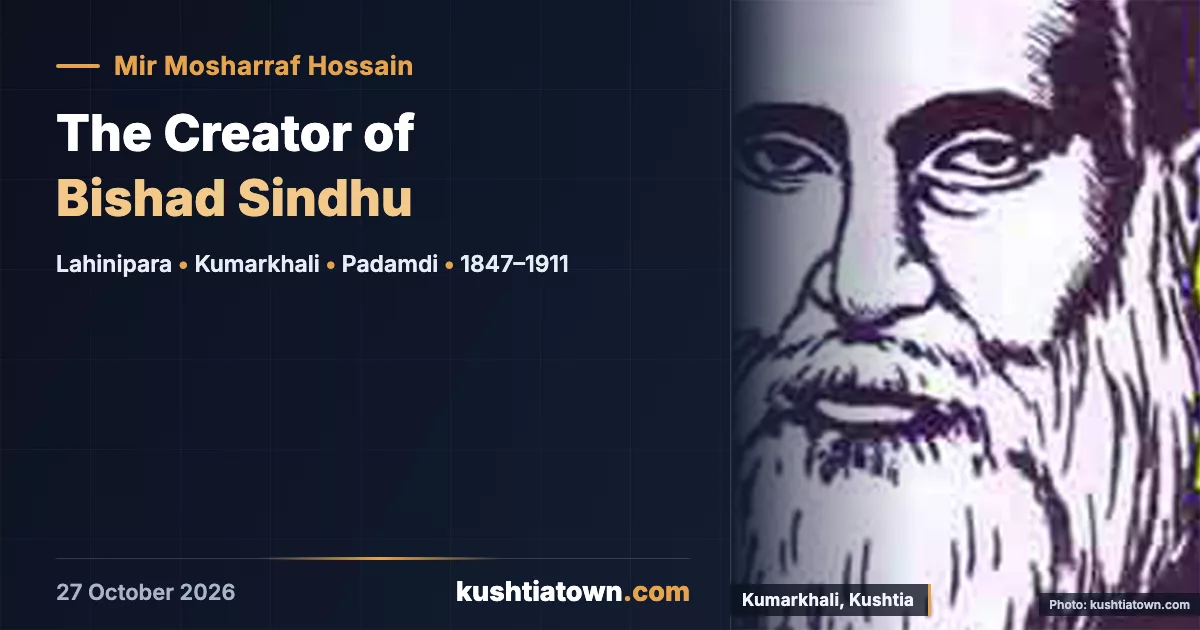
When the history of modern Bengali literature written by Muslims is told, the name that comes first is Mir Mosharraf Hossain of Lahinipara, Kumarkhali. In the very age of Bankim Chandra he produced novels and plays that became the first literary expression of the Bengali Muslim voice — and among them stands immortal 'Bishad Sindhu', in which the tragedy of Karbala found its own flowing Bengali form.
Born by the Gorai river, spending most of his life at the Padamdi Nawab Estate, trained into literature by Kangal Harinath himself, author of some thirty-six books — and, more than a century after his death, two memorial centres still fighting neglect: the life-story of Mir Mosharraf Hossain is arranged in exactly these chapters. This article presents a complete portrait of Kushtia's celebrated son, along with the present condition of his memorial sites.
Birth, Lineage and the Padamdi Nawab House
Mir Mosharraf Hossain was born in 1847 in the village of Lahinipara, Chapra Union, Kumarkhali upazila of Kushtia district, near the Gorai river. 13 November is the widely accepted birth date — Banglapedia and nearly every anniversary report celebrate his birthday on this day — though some researchers argue for 26 October, a discrepancy both Wikipedias record. The village was his maternal grandfather's home; his ancestral house stood at Padamdi, in present-day Nababpur Union of Baliakandi upazila, Rajbari district. The name of the village is often written 'Laxmipara' in popular usage, but the documented name is Lahinipara.
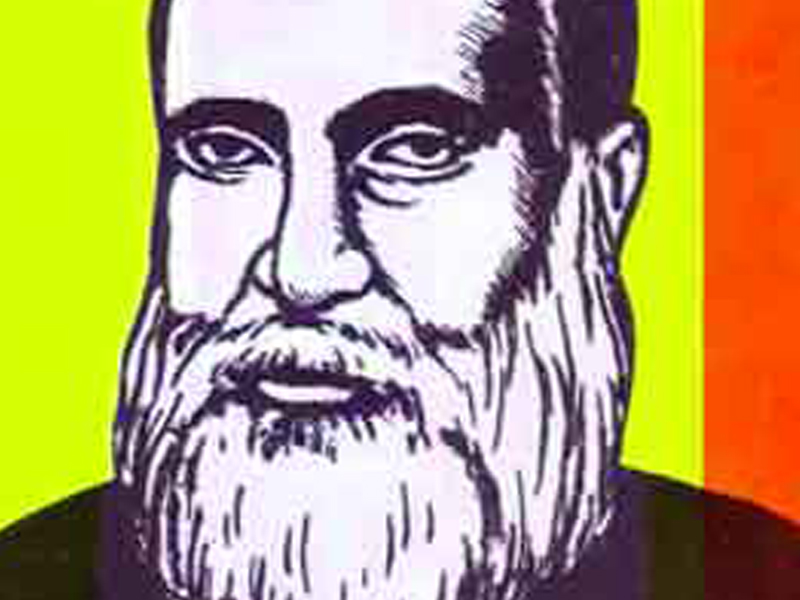
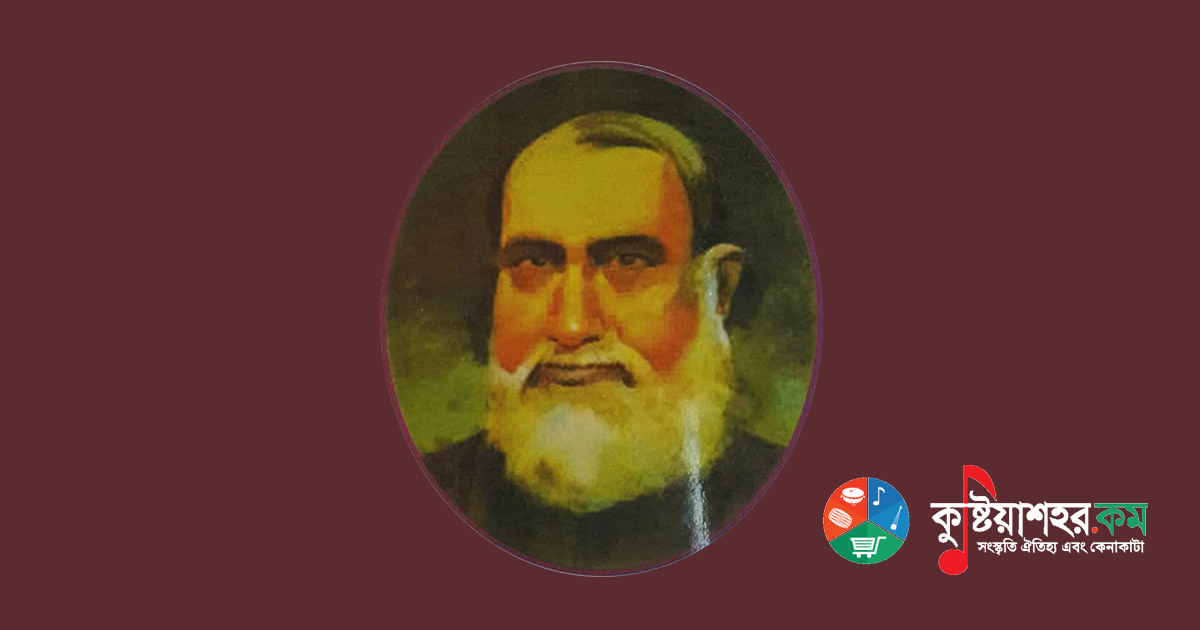
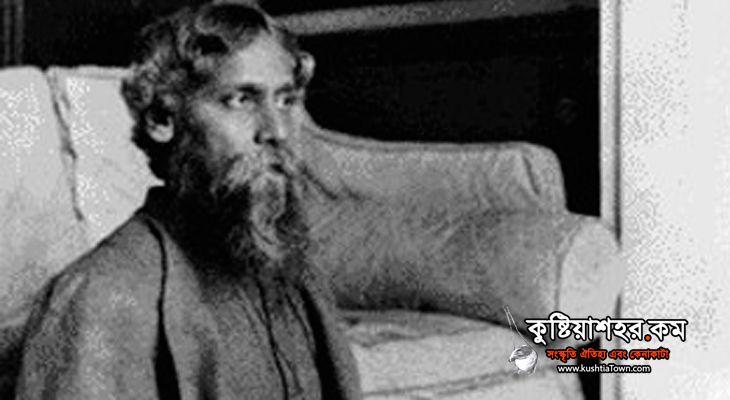
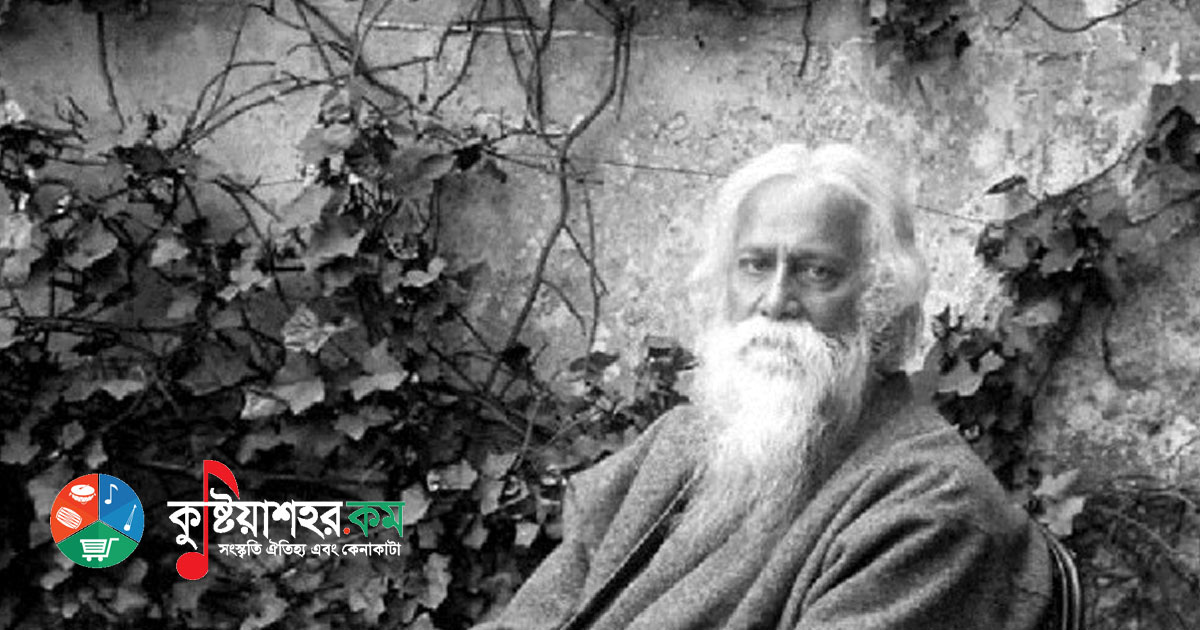
The familiar portrait of Mir Mosharraf Hossain (photo: kushtiatown.com)
His father Nawab Syed Mir Moazzem Hossain was a zamindar of the Padamdi Nawab Estate; his mother was Daulatunnesa Begum. The Padamdi Nawab family traces back five centuries: in 1607 Syed Shah Pahlawan received the area as a Mughal jaigir, and his son-in-law Syed Shah Sadullah Mir founded the Mir line — an honour said to have been conferred by Emperor Shah Jahan. Mir Moazzem's household produced Mosharraf Hossain, and most of the writer's life was spent in this very Nawab house of Padamdi.
Education
Schooling began at home — Arabic and Persian under a munshi, Bangla at a pathshala. Then came Kushtia School, the Padamdi Nawab School, Krishnanagar Collegiate School (up to Class V) and finally Kalighat School in Kolkata; but as Banglapedia puts it, his formal education went no further. His autobiography also mentions studies at Jagmohan Nandi's pathshala and the Kumarkhali English School. Limited institutional education, however, was more than compensated by his intimate command of Arabic, Persian and Bangla, and by relentless self-study.
Kangal Harinath and Grambarta Prakashika: The Beginnings
While still a student, Mir Mosharraf Hossain began writing as the mofussil correspondent of Sangbad Prabhakar and Grambarta Prakashika. The founding editor of Grambarta Prakashika was another legend of Kumarkhali — Kangal Harinath Majumdar, who, according to Banglapedia, was also the direct inspiration and patron of Mir Mosharraf's literary career. Mir himself wrote in his autobiography:
"Harinathbabu Mohashoy loved me like a younger brother."
The bond between these two men of Kumarkhali remains one of the most memorable chapters of Kushtia's cultural history. The fearless reporting of zamindar and indigo-planter oppression in Grambarta built the foundation of Mir's writerly vision — an experience that later crystallised into works like the social farce 'Zamindar Durpun'.
The Literary Career: Pioneer of Some Thirty-Six Books
Banglapedia ranks Mir Mosharraf Hossain "one of the foremost prose artists of the Bankim era and the pioneer of nineteenth-century Bengali Muslim writers." His verified bibliography contains close to thirty-six titles — a sweeping range of novels, plays, farces, religious biographies and memoirs.
The First Novel and the First Play by a Muslim
His first novel was 'Ratnavati' (1869) — described by Bangla Wikipedia as the first Bangla novel written by a Muslim. His play 'Basantakumari Natak' (1873) is regarded as the first Bangla drama by a Muslim author. In other words, one man introduced both the novel and the play into Bengali Muslim literary practice. Among his other works are 'Go-Jiban' (1889), 'Behula Gitabhinay' (1889), 'Niyati Ki Abanati' (1889), 'Udasin Pathiker Maner Katha' (1890), 'Tahmina' (1897), 'Gazi Miyar Bastani' (1899), 'Madinar Gaurab' (1906) and the memoir 'Amar Jibani' (1908–1910), besides 'Mussalmander Bangala Shiksha' (1903, 1908), a remarkable textbook of Bengali for Muslim learners.
From Peasant Revolt to the Gorai Bridge
1873 was a prolific year: three books appeared. One was 'Zamindar Durpun', a social farce set against the peasant uprising of Sirajganj (1872–73), exposing zamindari oppression in sharp satire. The most curious title for readers of Kushtia, however, must be 'Gorai-bridge or Gouri-Setu' (1873) — the Gorai river, the lifeline of Kushtia, itself entered the name of one of his books. The same river whose past and present we traced in our feature on the Gorai once inspired this nineteenth-century writer of Kumarkhali.
Bishad Sindhu: Karbala in Bengali
'Bishad Sindhu' was published in three volumes — the first (Mohorram Porbo) in May 1885, the second (Uddhar Porbo) in August 1887 and the third (Ejid-badh Porbo) in March 1891. Its subject is the tragedy of Karbala, the most sorrowful chapter of Islamic history — the sacrifice of Hazrat Husain. Banglapedia's verdict: "His immortal work Bishad Sindhu narrates the sorrowful historical tale of Karbala."
And it is for its language, not merely its subject, that 'Bishad Sindhu' earned a place in history. Instead of the Persian- and Arabic-laden Musalmani Bangla of the day, Mir Mosharraf wove a flowing blend of sadhu and colloquial Bengali that drew Hindu and Muslim readers alike. The book stands as his greatest and most popular creation; such was its fame across Bengal that in 2016 the Bangla Academy published an English translation, 'An Ocean of Sorrow', rendered by Fakrul Alam.
A Voice of Communal Harmony
Controversy also reached him from within his own community: for opposing cow-slaughter in his essay 'Gokul Nirmul Ashonka' he faced social sanctions — yet Banglapedia describes him as a writer free of communal prejudice. His remark on Hindu-Muslim brotherhood in 'Go-Jiban' remains strikingly relevant:
"In this Bengal both Hindus and Muslims are principal peoples. Their ties are so close that, though religions differ, in heart and in deed they share one household — we cannot but call each other brothers."
In 'Islamer Joy' he gave patriotism a defiant literary voice through Jafar's words: "If freedom must belong to another, then to lose one's life is better than to live as a slave." His stand on the mother tongue was equally unbending: "He who has no faith in his mother tongue is not a man."
Editor Mir Mosharraf and the Later Years
Besides being a writer he was a newspaper editor. He began with 'Azizannehar' (1874), named after his first wife Azizunnesa, and later edited 'Hitakari' (1890) — first from Lahinipara, later from Tangail, running intermittently for about five years. His working life also shifted phases: managing his father's estates, serving the Faridpur Nawab Estate (Padamdi), taking over as manager of the Delduar Estate in Tangail in 1885, and finally living in Kolkata from 1903 to 1909. He was also associated with the Bangiya Sahitya Parishad.
In private life he married Azizunnesa, daughter of a family friend, in 1865; his second marriage, to Bibi Kulsum, came in 1874.
Burial at Padamdi
Mir Mosharraf Hossain died on 19 December at Padamdi. Sources differ on the year — 1911 in prevailing Bangladeshi usage, 1912 in both editions of Banglapedia — but the date, 19 December, is undisputed, and his death anniversary is observed on this day every year. By his own last wish he was buried in the family graveyard at Padamdi, beside Bibi Kulsum. Born on Kumarkhali soil, working and resting at Padamdi — the greater Kushtia region holds his whole life between these two lands.
The Memorials Today
His memory now lies scattered across two districts — the birthplace at Lahinipara in Kushtia and the Padamdi memorial in Rajbari. Neither, however, is in good shape.
The Lahinipara Homestead
Of the original thirty-two bighas of the birth property, most is now under encroachment; barely three bighas remain. Still, a government primary school rose here in 1972, a library in 1992, a high school in 1995, and in 2008 the 'Mir Mosharraf Hossain Memorial Library, Auditorium and Museum' was built at a cost of 5.4 million taka. The site even appears on Kumarkhali upazila's official list of attractions. But neglect is not negligible: as recently as September 2026 newspapers reported the theft of the donation box from a museum of Mir Mosharraf Hossain (Ittefaq).
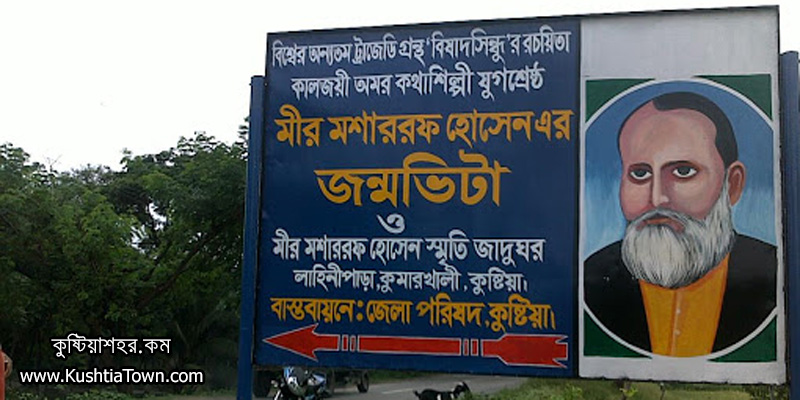
Signboard at the birthplace — (photo: kushtiatown.com)
The Padamdi Memorial Centre
The Padamdi Smriti Kendra was built under the supervision of the Bangla Academy with funding from the Ministry of Cultural Affairs — a 24.8-million-taka project on 1 acre 84 decimals of land, its foundation stone laid on 19 April 2001. A quarter century later the centre has slid into neglect: recent reports describe fungus and cracks on the walls, plaster peeling off, stolen lights, weekend closures and only two staff members to run the whole campus. Mir Mosharraf Hossain's books, the reports say, sit on the shelves waiting for readers.
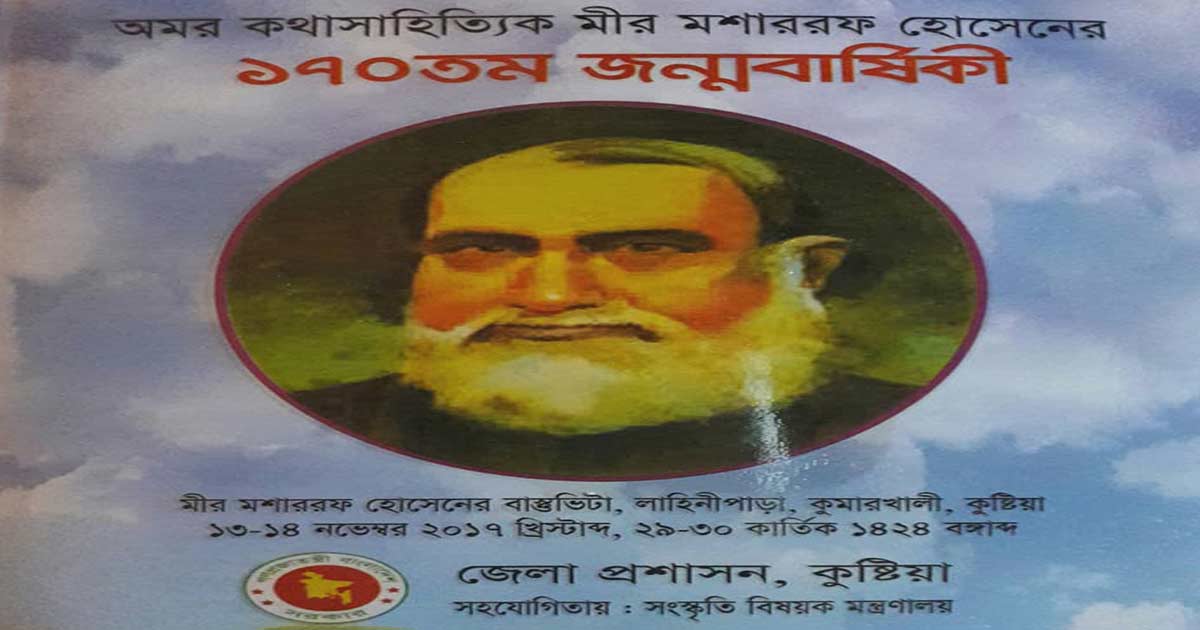
Poster of the 170th birth anniversary organised by the district administration, 2017 (photo: kushtiatown.com)
Conclusion
One life gave Bengali Muslim literature its first novel, its first play and its most beloved epic narrative — all bearing the signature of Mir Mosharraf Hossain. Lahinipara by the Gorai lies worn today, and the Padamdi memorial too is battered by neglect; yet every year on 13 November and 19 December admirers still come with flowers. The surest way to keep Mir Mosharraf Hossain alive, in the end, lies less in preserving bricks than in reading his books — for whenever the pages of 'Bishad Sindhu' turn, the sorrow of Karbala still weeps in Bengali.
Sources and Further Reading
- Banglapedia — "Hossain, Mir Mosharraf" (Bimal Guha): en.banglapedia.org
- Banglapedia (Bangla) — "হোসেন, মীর মশাররফ": bn.banglapedia.org
- Bangla Wikipedia — মীর মশাররফ হোসেন: bn.wikipedia.org
- Bangla Wikipedia — পদমদি নবাব: bn.wikipedia.org
- Bangla Wikipedia — মীর মশাররফ হোসেন স্মৃতিকেন্দ্র: bn.wikipedia.org
- Bangla Wikipedia — মীর মশাররফ হোসেনের বাস্তুভিটা: bn.wikipedia.org
- Kali O Kalom — "সম্পাদক মীর মশাররফ হোসেন": kaliokalam.com
- Nagorik Prothom Alo — "মীর মশাররফের স্বদেশপ্রেম ও মানবতাবোধ" (Aftab Chowdhury): nagorik.prothomalo.com
- Bangla Tribune — "লাহিনীপাড়ায় মীর মশাররফ হোসেনের স্মৃতির পথে" (September 2026): banglatribune.com
- Khoborsangjog — "অযত্নে-অবহেলায় মীর মশাররফ হোসেন স্মৃতিকেন্দ্র": khoborsangjog.com
- Dainik Shiksha — birth anniversary feature: dainikshiksha.com